Knee pain and knee injuries are often described in terms of specific structures. The ACL is one of the most commonly mentioned structures, especially in sports, but many people are unsure what it actually does or why it matters.
This article explains what the ACL is, where it sits in the knee, and how it contributes to stability. It also covers how ACL injuries typically occur, which symptoms are common after activity versus those that may indicate a ligament injury, and how ACL tears are typically managed.
If you have heard the term “ACL tear” and want a clear, practical explanation without hype or fear-based messaging, this guide will walk you through the basics and what to consider next.
What Is the ACL?

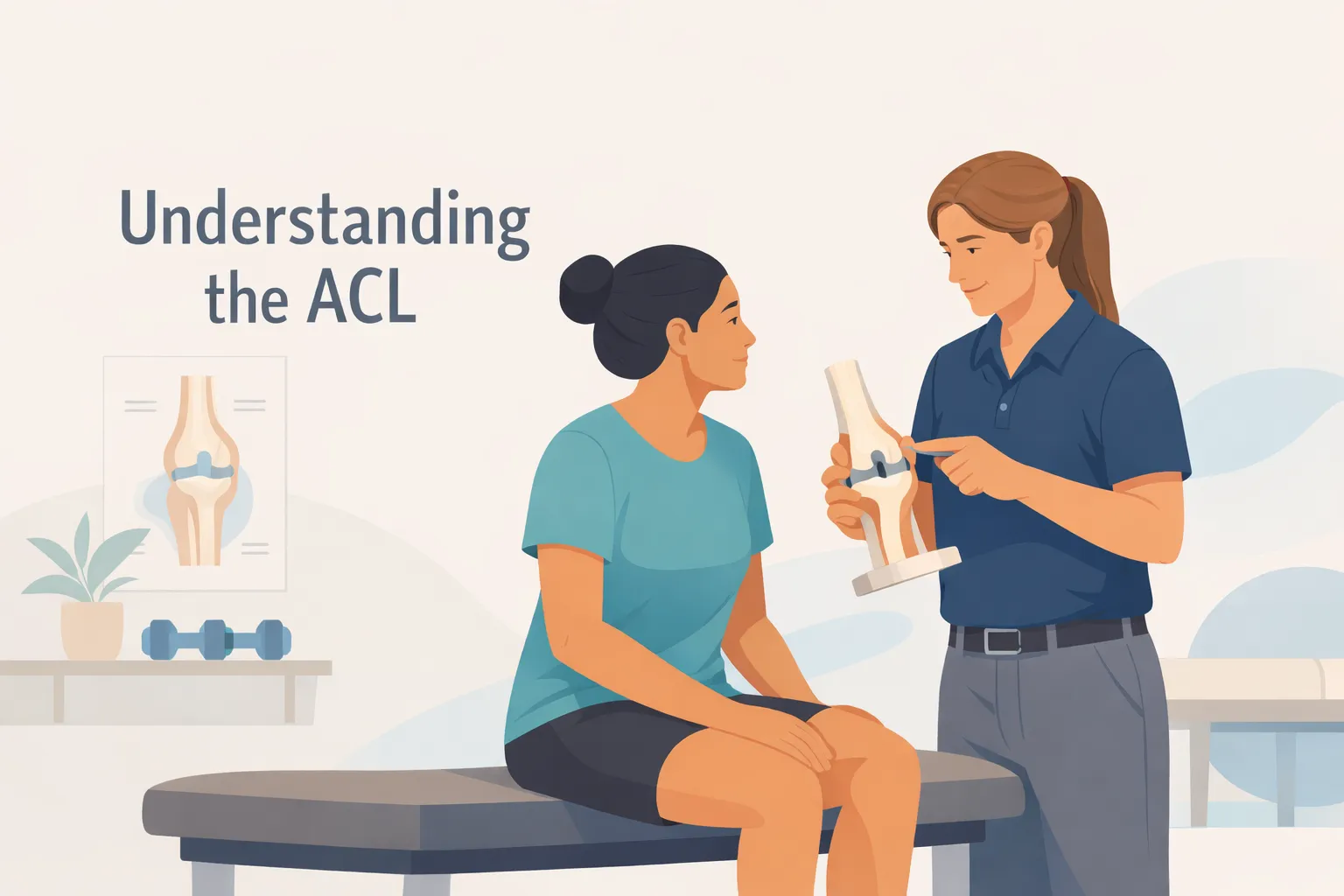
The anterior cruciate ligament (ACL) sits inside the center of the knee joint, connecting the femur to the tibia and helping control forward movement and rotation.
The ACL, or anterior cruciate ligament, is one of the primary stabilizing ligaments in the knee. It connects the femur (thigh bone) to the tibia (shin bone) and guides their relative motion.
Ligaments are dense bands of connective tissue. Their role is not to create movement, but to limit and control it. The ACL acts as a restraint against forward and rotational forces at the knee.
Although it is commonly discussed in the context of sports injuries, the ACL contributes to stability during everyday activities such as walking, stair climbing, and turning. It becomes especially important when movements are faster or less predictable.
Understanding what the ACL does helps explain why certain symptoms, such as instability or rapid swelling, may indicate more than simple soreness.
Where Is the ACL Located?
The knee joint is formed by three bones:
- The femur (thigh bone)
- The tibia (shin bone)
- The patella (kneecap)
The ACL sits inside the knee joint. It runs diagonally from the back portion of the femur to the front of the tibia. This orientation helps control both forward movement and rotation.
It crosses with another ligament, the posterior cruciate ligament (PCL), forming an “X” shape at the center of the knee. This crossing pattern allows the two ligaments to guide motion in opposite directions.
The ACL does not work in isolation. It functions alongside:
- The PCL
- The medial collateral ligament (MCL)
- The lateral collateral ligament (LCL)
- The surrounding muscles, especially the quadriceps and hamstrings
Knee stability is shared across these structures. The ACL provides restraint at specific points in motion, while muscles actively control and absorb force during movement.
What Does the ACL Do?
The ACL has two primary mechanical roles:
- It limits the forward movement of the tibia relative to the femur
- It helps control rotational forces at the knee
These roles become especially important during movements involving speed, changes in direction, or deceleration.
For example, when you plant your foot and pivot, the tibia wants to rotate and shift forward. The ACL resists that motion. It does not stop movement entirely. Instead, it guides it within a safe range.
During activities like:
- Cutting or pivoting
- Sudden stops
- Jumping and landing
- Rapid changes in direction
The ACL works with the surrounding muscles to maintain stability. The quadriceps, hamstrings, and hip muscles help absorb force and control alignment. The ligament provides passive restraint when loads increase.
It is important to understand that stability is not just a structural issue. It is also neuromuscular. Muscle activation timing, coordination, and strength all influence the magnitude of stress transmitted to the ACL.
This is why rehabilitation after ACL injury focuses on movement quality and strength development, not just on the ligament itself.
How Do ACL Injuries Happen?
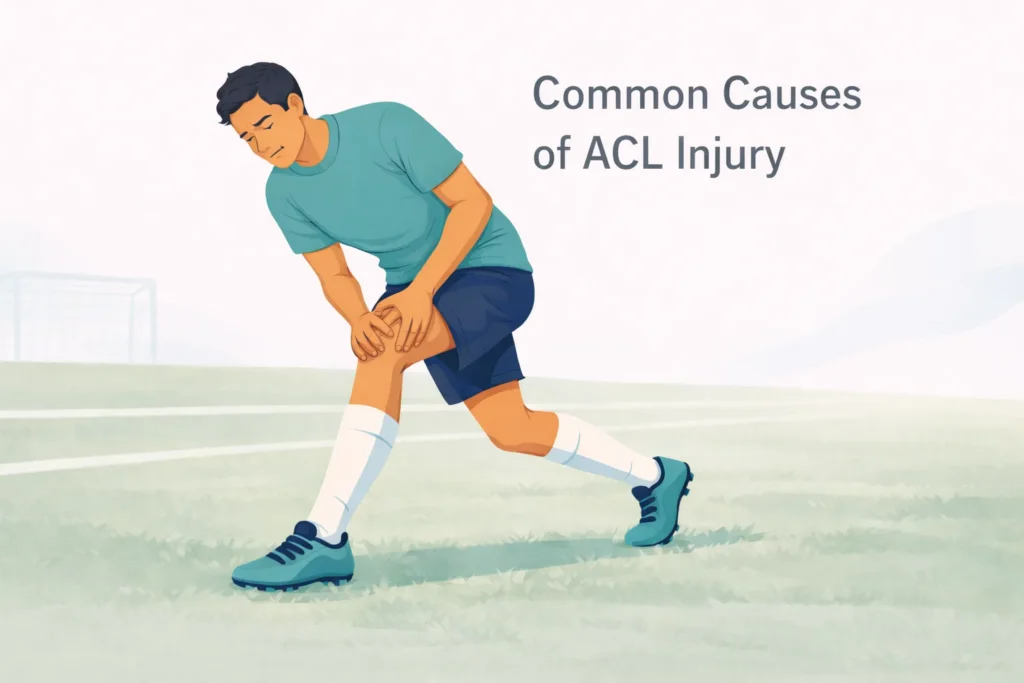
ACL injuries most commonly occur during non-contact movements. A typical mechanism involves planting the foot, twisting, and attempting to decelerate or change direction quickly.
In these moments, the knee experiences a combination of forward force and rotation. If that force exceeds the system’s current capacity, the ligament may tear partially or completely.
Common scenarios include:
- Landing from a jump with the knee collapsing slightly inward
- Sudden cutting during sports
- A rapid stop while running
- Direct contact that forces the knee into rotation
Sports such as soccer, basketball, football, and skiing have higher rates of ACL injury because they involve frequent changes in speed and direction.
It is important to note that ACL injuries are rarely caused by a single “wrong” movement. More often, they occur when high load meets fatigue, timing errors, or insufficient strength to control the motion.
In many cases, the ligament itself was not inherently weak. The load applied simply exceeded what the knee and surrounding muscles could tolerate at that time.
What Is Normal vs What May Be a Problem?
Not all knee pain or swelling indicates an ACL injury. Many knee symptoms are related to temporary irritation, increased training load, or normal tissue adaptation.
Distinguishing between soreness and true instability is key.
Normal After Activity
It is common to experience:
- General soreness after increasing activity
- Temporary stiffness, especially the next morning
- Mild swelling that settles within 24 to 48 hours
Soreness typically improves with light movement. The knee may feel tired or achy, but it does not feel unstable. You can usually walk, turn, and bear weight without the sensation that the knee might give out.
These symptoms are more consistent with tissue adaptation than structural disruption.
Signs That May Suggest ACL Involvement
An ACL injury more often includes:
- A popping sensation at the time of injury
- Rapid swelling within a few hours
- Difficulty bearing weight immediately after
- A feeling of instability or buckling
Instability is often the most meaningful symptom. Pain alone does not confirm ligament injury. Many knee structures can be painful. A sense that the knee cannot be trusted during walking, pivoting, or descending stairs is more specific.
Persistent swelling, limited range of motion, or recurrent episodes of giving way are also reasons to seek evaluation.
How Is an ACL Injury Diagnosed?
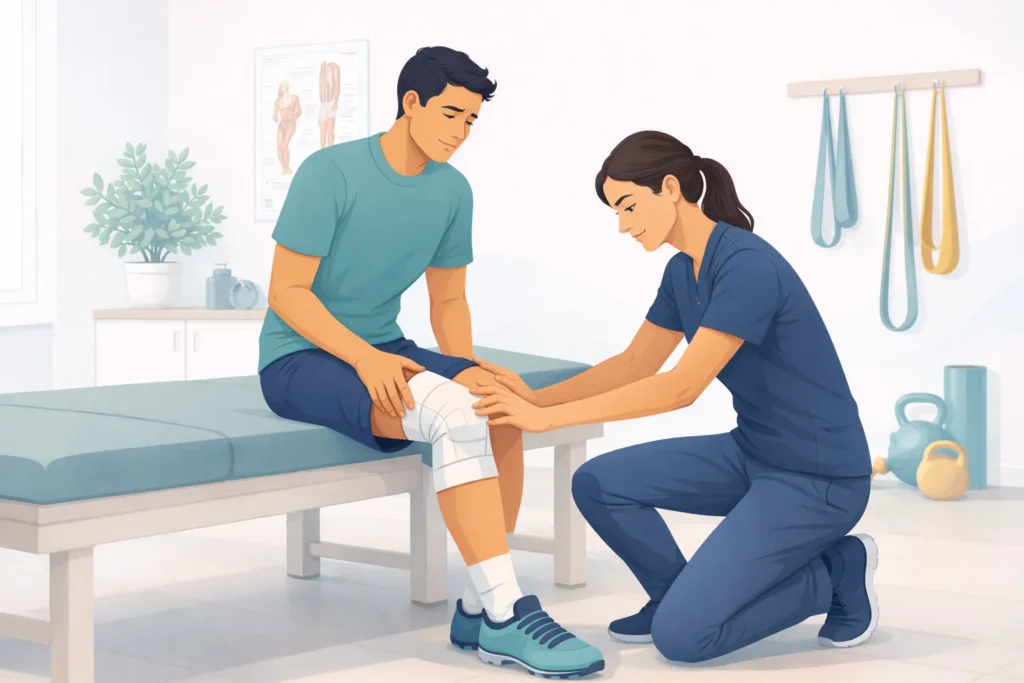
Diagnosis begins with a detailed conversation about how the injury occurred. The mechanism matters. A twisting injury with rapid swelling tells a different story than gradual soreness after increasing activity.
A physical examination follows. This includes assessing swelling, range of motion, strength, and specific ligament tests that evaluate tibial motion relative to the femur. These hands-on tests help determine whether the ACL is providing normal restraint.
Movement assessment is also important. Observing how someone walks, squats, or shifts weight can reveal instability or compensation patterns that influence decision-making.
Imaging, such as MRI, may be used to confirm the diagnosis or identify associated injuries, such as meniscal tears or cartilage involvement. However, imaging findings alone do not determine treatment. Symptoms, functional demands, and personal goals are equally important in guiding next steps.
Do All ACL Tears Require Surgery?
No. Not all ACL tears require surgery.
Treatment decisions depend on how the knee functions and what demands you plan to place on it. Important considerations include:
- Activity level
- Desire to return to pivoting or cutting sports
- Degree of instability during daily tasks
- Presence of associated injuries, such as meniscus damage
- Personal goals and comfort with risk
Some individuals regain sufficient stability through rehabilitation alone, particularly if their activities do not involve high-speed direction changes. Others choose reconstruction because their sport or occupation requires greater rotational control.
There is no universal rule that every ACL tear must be reconstructed. National orthopedic guidelines also note that not every ACL injury requires surgical reconstruction. What matters most is how the knee performs under load and whether instability limits function.
Current evidence supports shared decision-making. Both surgical and non-surgical pathways can lead to good outcomes when rehabilitation is structured, progressive, and aligned with the individual’s goals.
What Does Rehabilitation Focus On?
Whether someone has surgery or not, rehabilitation focuses on restoring capacity. The goal is not simply to calm symptoms, but to rebuild the knee’s ability to tolerate real-world demands.
Early stages often emphasize:
- Reducing swelling
- Restoring full knee extension and flexion
- Re-establishing basic muscle activation, especially in the quadriceps
As pain and swelling settle, the focus shifts toward strength and movement control. This includes:
- Progressive strengthening of the quadriceps and hamstrings
- Improving hip and trunk strength to support knee alignment
- Rebuilding balance and coordination
- Gradually increasing load tolerance through functional tasks
The ACL is only one part of the system. Muscles absorb and distribute force. When strength, timing, and coordination improve, stress on passive structures such as ligaments can decrease.
Rehabilitation is not about avoiding load. It is about applying load in a structured, progressive manner so the knee adapts. Tissues respond to appropriate stress. The key is dosing that stress correctly.
For individuals returning to sport, later stages of rehab include controlled exposure to cutting, pivoting, and sport-specific movements. Progression is based on performance and tolerance, not just time since injury or surgery.
Load, Capacity, and Long-Term Outlook
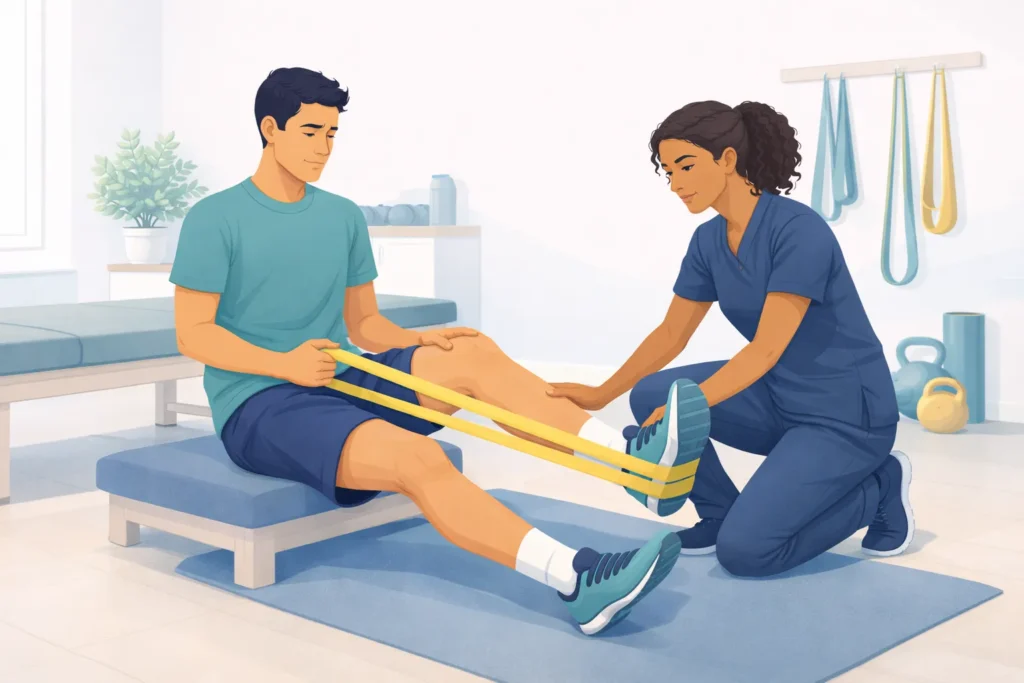
It can be helpful to think about ACL injuries through the lens of load and capacity.
Load refers to the stress placed on the knee during movement. Capacity refers to what the joint and surrounding system can tolerate at that moment. When the load exceeds the capacity, injury can occur.
Rehabilitation is designed to increase capacity in a structured way. Strength, coordination, and movement control all improve the knee’s ability to safely manage higher forces. As capacity improves, everyday and athletic activities fall within a safer range.
This framework also explains why timelines vary. Two people with similar ACL injuries may recover at different rates depending on:
- Baseline strength
- Movement quality
- Activity demands
- Consistency with rehabilitation
With appropriate management:
- Many individuals return to sport
- Many regain full function in daily life
- Long-term outcomes are often favorable
Returning to high-level pivoting sports does carry a risk of re-injury. That risk is influenced by strength symmetry, movement control, fatigue, and decision-making under speed. Structured return-to-sport testing helps guide this transition.
Recovery is not defined by a single date on a calendar. It is defined by how the knee performs under gradually increasing demands.
An ACL injury does not automatically mean the knee is permanently unstable or fragile. With the right progression, most people regain confidence and meaningful function.
What About Long-Term Knee Health?
There is an association between ACL injury and the later development of knee osteoarthritis. However, this relationship is influenced by multiple variables and is not determined solely by the ligament injury.
Contributing factors can include:
- Associated injuries, such as meniscus damage
- Persistent instability over time
- Quadriceps weakness
- Activity patterns and overall joint loading
The presence of an ACL tear does not guarantee long-term joint problems. Many individuals maintain high levels of function for years after injury, particularly when strength and movement capacity are restored.
Ongoing strength training, regular physical activity, and thoughtful load progression are protective strategies for joint health. The knee responds well to appropriate stress. Avoiding activity altogether is rarely the solution.
Long-term outcomes are influenced less by the diagnosis itself and more by how the knee is managed over time.
When to Consider a Physical Therapy Evaluation
Not every knee injury requires urgent care. Many symptoms improve with time and gradual return to activity. However, certain patterns suggest that a structured assessment would be helpful.
You may benefit from evaluation if you notice:
- Repeated instability or episodes of the knee giving way
- Persistent swelling that does not improve
- Loss of motion that limits daily tasks
- Difficulty returning to running, sport, or higher-level activity
- Uncertainty about how to safely progress with activity
A physical therapy evaluation focuses on how your knee performs under load. This includes assessing strength, movement control, balance, and tolerance to functional tasks. The goal is to understand both the structure and the system around it.
Even if surgery is being considered, early rehabilitation can help restore motion, reduce swelling, and improve overall outcomes. If surgery is not planned, rehabilitation can help determine whether the knee can function reliably at your desired activity level.
If you are unsure about your symptoms or next steps, a movement assessment can provide clarity. The objective is not simply to confirm a diagnosis, but to outline a practical plan that matches your goals and activity demands.
Tags

About the Author
Dr. Traci Smiley, DPT
Traci is a licensed physical therapist and owner of Calibration Physical Therapy, serving the Kansas City area. A Board-Certified Orthopedic Clinical Specialist with advanced training in manual therapy and strength conditioning, she helps individuals overcome pain and return to what they love.