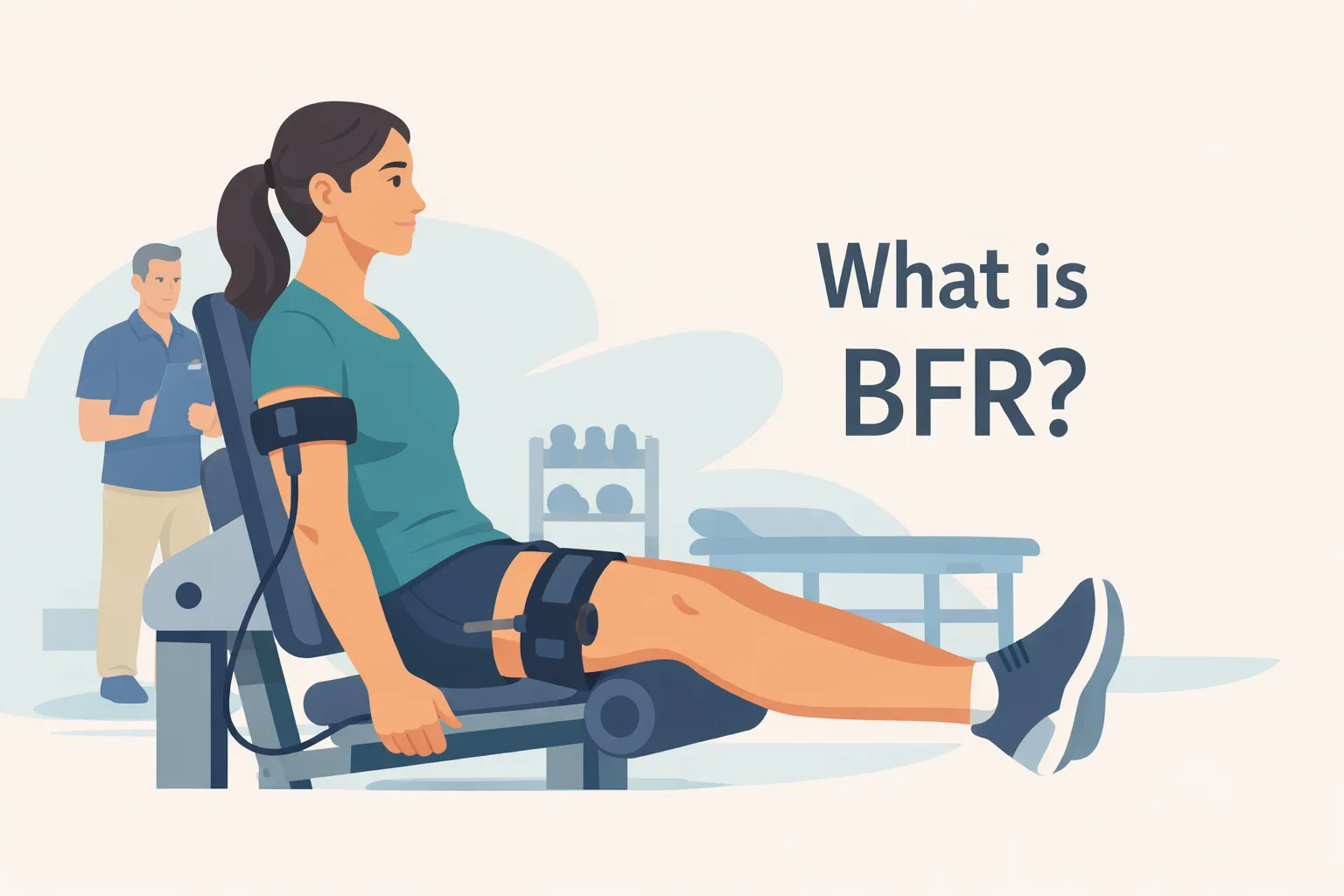
Rebuilding strength after an injury or surgery can be challenging, especially when heavier resistance is not yet appropriate. In some cases, muscle needs a stimulus before a joint, tendon, or surgical repair can tolerate traditional loading. Blood Flow Restriction therapy, commonly called BFR, can help fill that gap.
BFR is a rehabilitation technique that allows patients to strengthen their muscles with lighter weights while still eliciting a meaningful training response. When used appropriately and under supervision, it can support strength development during earlier phases of recovery.
What is Blood Flow Restriction (BFR) Therapy?
Blood Flow Restriction therapy, often called BFR, is a strengthening method used in rehabilitation that allows patients to build or maintain muscle using lighter weights than traditional resistance training.
It is commonly used when rebuilding muscle is important, but heavier loading is not appropriate. This may include post-operative recovery, joint irritation, or situations where pain limits strength training.
BFR does not replace progressive strengthening. Instead, it allows therapists to create a meaningful muscle stimulus during phases of rehab when heavier resistance would place too much stress on healing tissue.
When used correctly, it is individualized, monitored, and integrated into a broader plan of care.
How BFR Works

BFR uses an inflatable cuff placed around the upper arm or upper thigh. The cuff partially restricts blood flow to the limb while still allowing blood to enter the limb.
This creates a temporary change in the muscle’s environment during exercise. Because blood leaves the working muscle more slowly, fatigue and metabolic stress build within it.
Even though the external load is light, the muscle still experiences high fatigue. Over time, this can help preserve or rebuild strength when heavier resistance is not yet appropriate.
What the Cuff Does
The cuff limits venous return while maintaining arterial inflow. As a result:
- The muscle fatigues more quickly
- Metabolic stress increases
- Additional muscle fibers are recruited earlier
This provides a meaningful training stimulus even with a light external load.
Why Light Weights Can Still Build Strength
Over the past two decades, research has examined BFR across athletic, post-operative, and general populations. Systematic reviews suggest that low-load BFR can produce meaningful gains in strength and hypertrophy while using significantly lighter resistance than traditional training.
These findings apply when BFR is delivered using individualized pressure and supervised protocols.
This can be helpful when:
- Heavier movements are restricted
- Tendons are sensitive to load
- Joint compression needs to be minimized
As tolerance improves, patients transition back to traditional strengthening.
Why BFR Is Used in Physical Therapy
BFR is most useful when strength loss is a concern and traditional loading options are limited.
After surgery or injury, muscle weakness can develop quickly. When a joint or repair cannot tolerate heavier resistance, BFR provides a way to challenge the muscle without overloading healing tissue.
Its use is based on clinical reasoning and specific recovery goals. It is selected intentionally, not routinely.
For example, after ACL reconstruction, early quadriceps weakness is common and can persist if not addressed appropriately. If the knee cannot tolerate heavy loading yet, BFR may be used with lighter exercises such as leg extensions or mini squats to help maintain muscle activation while protecting the surgical repair.
Preventing or Reducing Muscle Loss
Muscle atrophy can begin within days after surgery or injury, especially when activity is restricted.
This is common after procedures such as:
- ACL reconstruction
- Meniscus repair
- Rotator cuff surgery
- Labral repairs
- Periods of immobilization
When heavy strengthening is not allowed, BFR can help maintain or rebuild muscle during this phase.
It does not speed up tissue healing. Its role is to support muscle capacity while precautions are in place.
Supporting Early-Stage Rehabilitation
Early rehab often prioritizes protecting healing structures by limiting the range of motion or load.
BFR allows meaningful muscle work while keeping external resistance low. This can help reduce strength loss during more restrictive phases of recovery.
As tolerance improves, loading progresses accordingly.
Managing Joint Sensitivity
Some individuals experience joint pain during heavy lifting, even when tissue healing is complete. BFR can allow muscle training with less joint stress.
This may be helpful in:
- Knee osteoarthritis
- Patellofemoral discomfort
- Persistent shoulder pain
The goal remains progressive strengthening. BFR simply provides an option when heavier loading is not well tolerated.
What a BFR Session Looks Like

A BFR session in physical therapy is structured, measured, and individualized. The therapist determines whether BFR is appropriate for your current stage of recovery and integrates it into your plan of care. Sessions typically include screening, individualized cuff placement, and supervised exercise progression.
Screening and Evaluation
Before using BFR, a therapist reviews:
- Medical history
- Cardiovascular status
- Blood pressure
- History of clotting disorders
- Current medications
- Surgical details, if applicable
Not everyone is an appropriate candidate, so screening is essential.
Cuff Placement and Pressure

The cuff is placed high on the upper arm or thigh, not over joints or surgical sites.
Pressure is individualized using measured limb occlusion pressure, ensuring a consistent and controlled level of restriction.
Comfort and tolerance are monitored throughout the session.
Exercise Structure
Exercises use light resistance and specific repetition schemes, typically:
- One higher-repetition set
- Followed by shorter sets
- With brief rest periods
Movements depend on the area being treated and may include leg presses, straight-leg raises, mini squats, or upper-body exercises.
The BFR portion usually lasts several minutes and is one component of a broader rehab session.
Patients often alternate between brief exercise periods and short rest intervals while the cuff remains inflated. The total time under restriction is limited and monitored carefully. Once the sets are complete, the cuff is deflated and circulation returns to normal before moving on to the next component of the session.
What BFR Feels Like
Most patients describe BFR as muscle fatigue and pressure rather than joint strain.
Because blood leaves the muscle more slowly during exercise, fatigue builds quickly, even with light weights.
Common sensations include:
- Tightness in the limb
- Early muscle fatigue
- A temporary “pump” sensation
- Mild warmth
These responses are expected and related to muscle effort.
BFR should not cause sharp pain, numbness, tingling, or dizziness. If unusual symptoms occur, the exercise is stopped and reassessed.
After the cuff is removed, normal blood flow resumes quickly.
Safety and Contraindications
When properly screened and supervised, BFR has been shown to be safe in clinical populations studied in current research. Recent reviews continue to support the safety of properly applied BFR when individualized pressure and screening protocols are followed.
It may not be recommended for those with:
- Active or recent blood-clotting disorders
- Uncontrolled hypertension
- Certain vascular or cardiac conditions
- Active limb infection
- Pregnancy in some cases
Unsupervised attempts using improvised straps or excessive compression do not provide the same controlled environment and are not recommended.
At Calibration Physical Therapy, BFR is used selectively and integrated into a broader rehabilitation plan.
How BFR Fits Into a Larger Rehab Plan
BFR is a temporary strategy within a structured and progressive rehabilitation plan.

Early stages of rehab focus on protecting healing tissue. As tolerance improves, strengthening progresses toward heavier resistance and functional movement.
BFR is typically used during early or mid-stages when traditional loading is limited.
As recovery advances, patients transition toward:
- Heavier resistance
- Full range strengthening
- Functional and sport-specific training
The long-term goal remains the restoration of strength, confidence, and function.
Who Typically Benefits Most From BFR?
BFR is most commonly used in individuals who are temporarily limited by surgical precautions or joint sensitivity rather than general deconditioning.
This may include:
- Athletes recovering from ligament reconstruction
- Active adults returning from shoulder or knee surgery
- Individuals experiencing strength loss during periods of reduced weight-bearing
- Patients who are unable to tolerate heavier resistance due to joint pain
It is less commonly used when traditional strengthening can be performed safely and comfortably. The goal is always to use the simplest effective approach for the situation.
FAQs About BFR
Is this the same as wrapping a band tightly around my leg at the gym?
No. Clinical BFR uses medical-grade equipment and measured pressure settings. Improvised bands do not provide the same control or safety.
Does BFR build muscle as effectively as heavy lifting?
In rehabilitation settings, low-load BFR training can support strength development when heavy lifting is not appropriate. It is not a replacement for long-term progressive overload.
Is it painful?
It can feel intense in the muscle due to fatigue, but it should not cause sharp joint pain or concerning symptoms.
How long is BFR used during rehab?
It varies. Some patients use it for several weeks. Others discontinue once traditional strengthening is tolerated.
Will BFR speed up healing?
No. It supports muscle strength during recovery but does not accelerate tissue healing timelines.
When to Consider BFR

You may consider discussing BFR with a physical therapist if:
- You are recovering from surgery and experiencing muscle loss
- Heavier lifting increases joint discomfort
- You are limited to low-load exercise, but need greater strength stimulus
Not all patients require BFR. A thorough evaluation determines whether it would meaningfully improve your progression.
Final Thoughts
Blood Flow Restriction therapy is a structured rehabilitation tool that allows meaningful muscle work when heavier loading is not appropriate.
It does not replace progressive strengthening or accelerate biological healing. Instead, it helps preserve and rebuild muscle during phases when traditional resistance must be limited.
When used selectively and integrated into a comprehensive plan of care, BFR can support a smoother transition from early protection to higher-level strength and function.
If you are unsure whether BFR is a good fit for your situation, a movement assessment at Calibration Physical Therapy can help determine the most appropriate next step based on your goals, medical history, and current stage of recovery.
Tags

About the Author
Dr. Traci Smiley, DPT
Traci is a licensed physical therapist and owner of Calibration Physical Therapy, serving the Kansas City area. A Board-Certified Orthopedic Clinical Specialist with advanced training in manual therapy and strength conditioning, she helps individuals overcome pain and return to what they love.