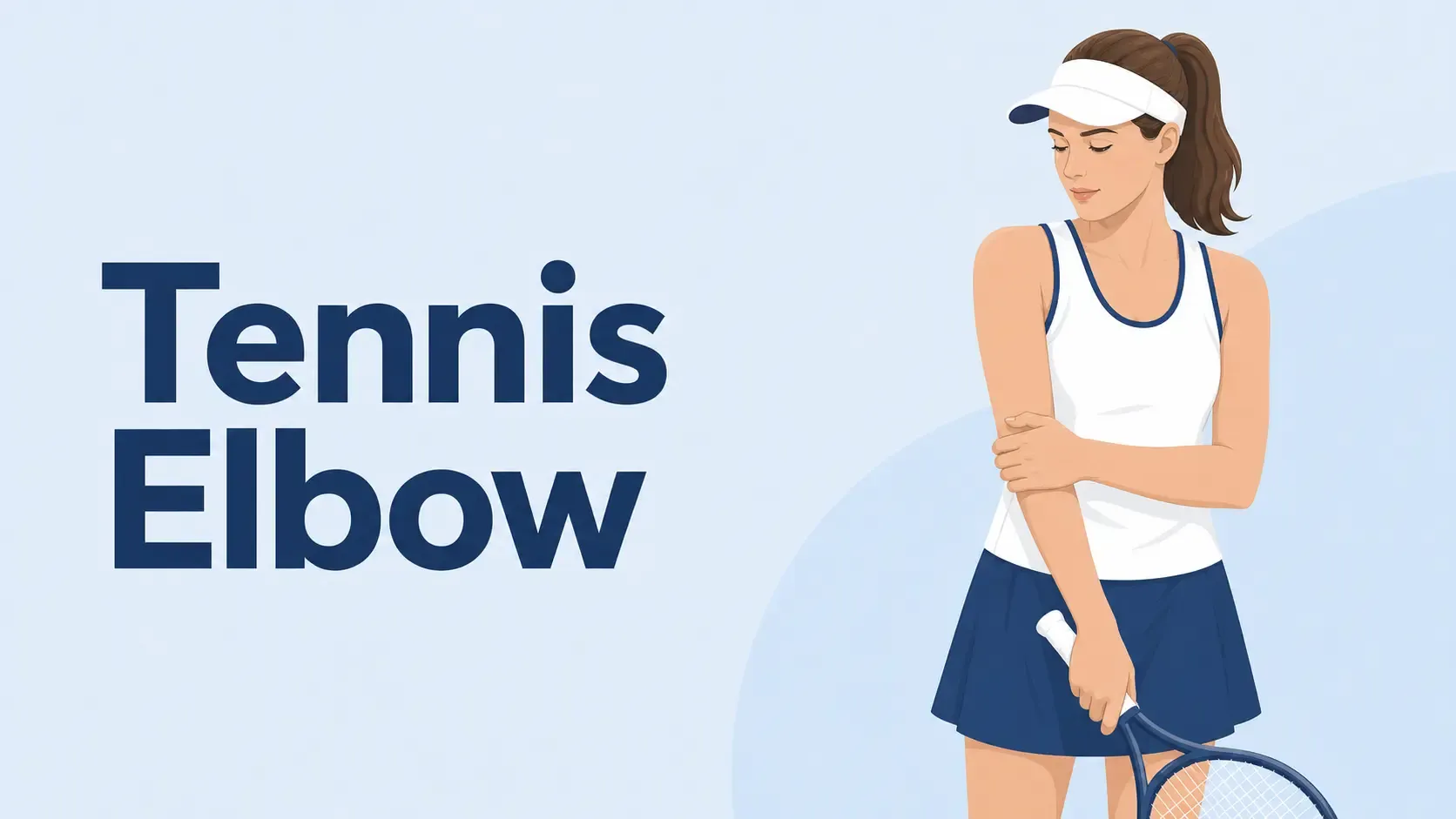
You may notice tennis elbow when a coffee mug feels heavier than usual, opening a jar becomes uncomfortable, or your grip fades during a workout. The pain may show up while lifting a pan, using a screwdriver, carrying a bag, typing, or playing tennis or pickleball. It often feels like a sore spot on the outside of the elbow that becomes more noticeable as the arm works.
Tennis elbow can affect people who have never played tennis. Active adults, recreational athletes, tradespeople, office workers, and anyone who has recently increased gripping or lifting may develop similar symptoms. The common factor is repeated loading of the forearm and wrist, not the name of the sport.
The condition often develops gradually when a new racquet, more frequent practice, heavier strength training, longer work shifts, or less recovery increases the demand on the arm.
This article explains what causes tennis elbow, how symptoms behave, how physical therapy evaluates and treats it, and how to return to activity without repeatedly irritating the elbow.
Quick Answer
Tennis elbow, also called lateral elbow tendinopathy, is pain around the outside of the elbow that is often reproduced by gripping, lifting, or extending the wrist against resistance. It usually develops when repeated forearm loading exceeds the arm’s current ability to recover and adapt. The term “tendinopathy” describes a pattern of pain and reduced load tolerance, not necessarily a serious tear or permanent damage.
The problem is not limited to tennis players, and it is not always caused by one poor movement. Symptoms may follow changes in racquet sports, pickleball, weight training, manual work, computer use, or other repetitive tasks.
Physical therapy usually combines activity modification with progressive strengthening. The goal is to improve the forearm’s tolerance for gripping and lifting while gradually restoring the specific activities that matter to you.
What Causes Tennis Elbow?
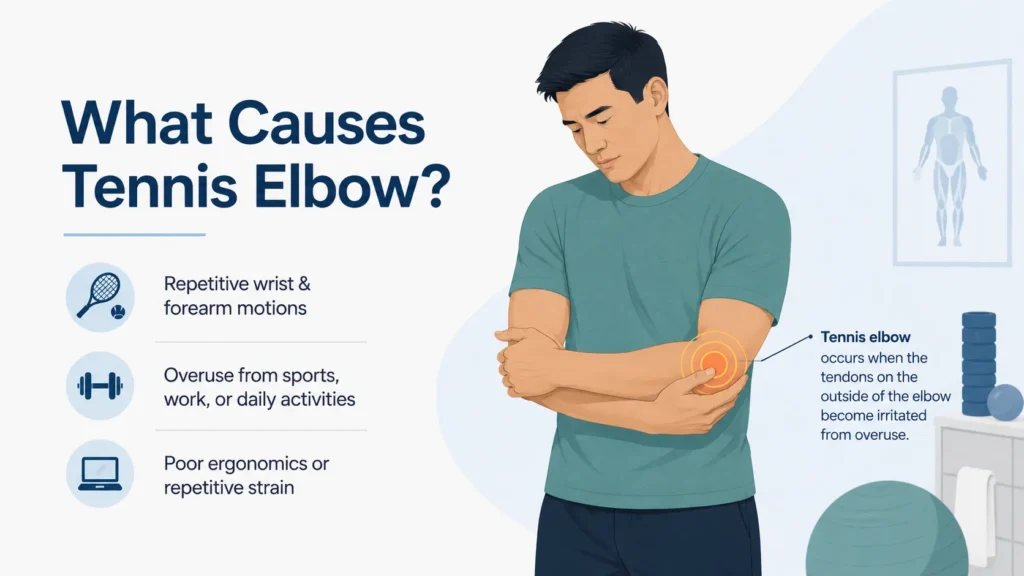
Several muscles that control the wrist and fingers attach near the outside of the elbow. These muscles help stabilize the wrist when you grip, carry, lift, or use a racquet. They work harder when the wrist needs to remain steady while the hand produces force.
A sudden increase in this type of loading can make the tendons more sensitive and less tolerant of normal activity. Common examples include adding another tennis or pickleball session, using a heavier racquet, starting a new lifting program, increasing pull-ups, or taking on more manual work.
The position of the wrist and forearm can also change the demand. Carrying a box with the palm facing down, lifting a pan by its handle, or using a tool for several hours may be more provocative than the same task performed with a different grip or less repetition.
Tennis elbow is usually influenced by the relationship between load and capacity. The same activity may be manageable after good sleep and a lighter week but aggravating after several demanding sessions with little recovery. This does not mean that one movement is damaging the elbow. It means the total demand may currently be higher than the arm can tolerate.
Why Tennis Elbow Often Develops Gradually
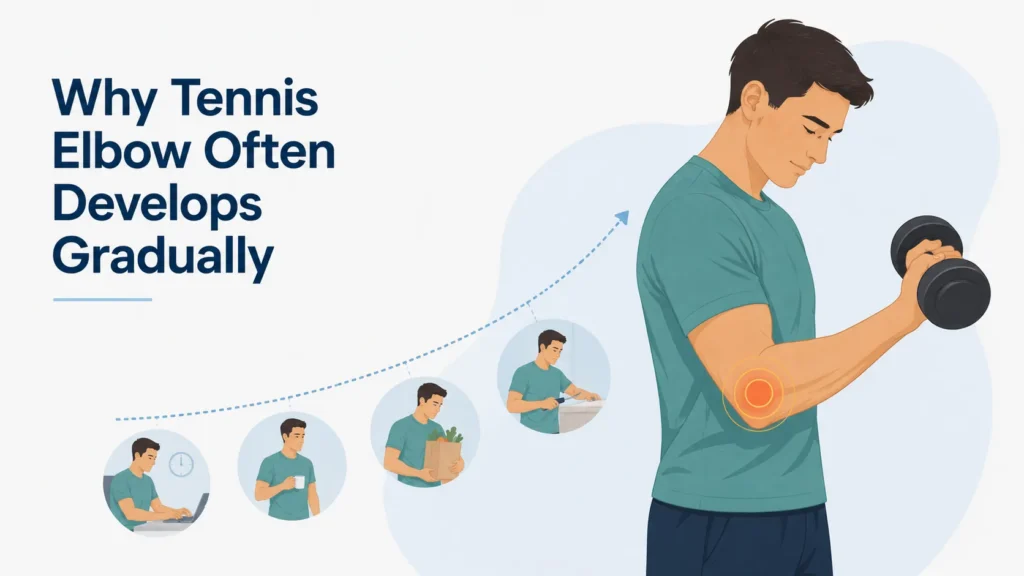
Tendons respond to repeated loading over time. They can adapt when the amount of stress increases at a manageable pace, but symptoms may develop when workload rises faster than the body can adjust.
Consider a recreational tennis player who normally plays once a week and then joins a weekend tournament. The change may involve more serves, more backhands, longer rallies, and fewer rest days all at once. The elbow may feel fine during the first match and become sore that evening or the following morning.
A similar pattern can occur at work. A new project may require longer hours at a computer, more lifting, or repeated use of a hand tool. Each change may seem minor, but the combined exposure can add up over several days.
Fatigue and recovery also matter. Poor sleep, a busy work schedule, or returning to activity after time away can reduce the amount of load the arm handles comfortably. Gradual onset does not mean the pain is imaginary or that the elbow is necessarily seriously injured. It gives us a reason to examine the full pattern of loading and recovery.
What Does Tennis Elbow Feel Like?
Tennis elbow usually causes pain or tenderness around the bony area on the outside of the elbow. Some people describe a localized ache, while others notice burning, soreness, or a feeling that the arm is weak when gripping.
Common activities that may reproduce symptoms include:
- Gripping a racquet, dumbbell, coffee mug, steering wheel, or tool
- Opening a jar or turning a doorknob
- Lifting a pan, briefcase, or grocery bag
- Typing or using a mouse for long periods
- Serving, hitting a backhand, or playing pickleball
- Pulling, carrying, or doing repetitive work with the wrist extended
The elbow may hurt more after activity than during it. You may finish a workout or match with only mild discomfort and notice increased soreness later in the day or the next morning. Some people also notice reduced grip strength or less confidence using the arm, even when formal strength has not been tested. This delayed response is one reason a physical therapist asks about the hours after activity, not just what happened during the session.
Numbness, tingling, significant swelling, pain that travels from the neck, or progressive weakness may suggest another or additional problem. These symptoms deserve a more complete evaluation rather than assuming the pain is tennis elbow.
How Symptoms Behave During Activity
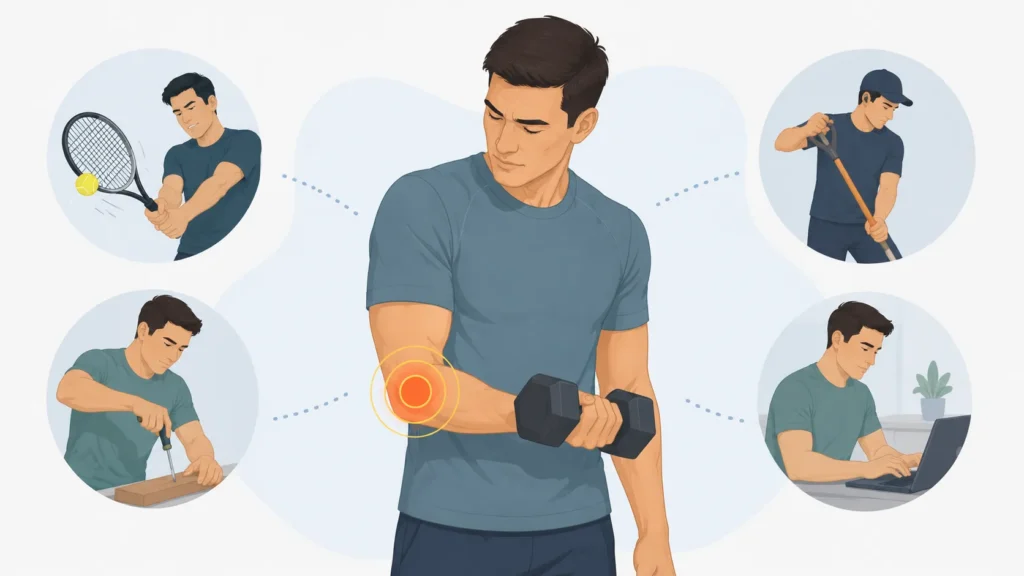
Tennis elbow symptoms often increase with repetition. The first few lifts may feel acceptable, but gripping can become more painful as the forearm becomes fatigued. A tennis player may tolerate easy groundstrokes but notice symptoms during serves, high-effort backhands, or a long rally.
The amount of force matters, but so do speed, duration, grip intensity, and recovery time. Carrying a light bag for a few minutes may be comfortable, while carrying the same bag across a large store may become painful. A short typing session may be fine, while a full workday may leave the elbow sore.
A useful question is not only, “Did this activity hurt?” It is also, “How did the elbow respond afterward?” Mild symptoms that remain controlled, do not change how you move, and return close to baseline by the next day may be manageable. Pain that steadily increases during the task, changes how you move, or remains noticeably elevated the next morning suggests that the current workload needs to be adjusted.
This does not require tracking every sensation or avoiding all discomfort. It means using the response over the next 24 hours to decide whether to repeat, reduce, or progress the activity. That approach allows you to keep moving while choosing a starting point the arm can recover from.
Tennis Elbow vs. Golfer’s Elbow
Tennis elbow and golfer’s elbow both involve the forearm and can make gripping uncomfortable, but the location and provoking movements are often different.
| Feature | Tennis elbow | Golfer’s elbow |
|---|---|---|
| Usual pain location | Outside of the elbow | Inside of the elbow |
| Commonly aggravated by | Wrist extension, gripping, lifting with the palm down, backhands | Wrist flexion, gripping, lifting, and throwing motions |
| Common examples | Racquet backhands, screwdriver use, carrying a bag | Golf swings, throwing, pulling, or forceful wrist movements |
Pain location is helpful, but it does not confirm the diagnosis by itself. Symptoms may also come from the elbow joint, a ligament, a nerve, the neck, or an acute injury. A physical therapist uses the history and examination to determine which movements and tissues are most relevant.
This distinction matters because treatment should match the actual source of symptoms. If elbow pain is accompanied by numbness, tingling, major swelling, locking, or a clear traumatic event, a broader evaluation may be needed.
Common Mistakes People Make When Symptoms Start
When elbow pain starts, people often respond in ways that make the next step harder to judge. The most common problems are not a lack of effort, but using too much or too little activity without a clear progression.
- Stopping everything for too long: Rest may reduce irritation temporarily, but the elbow still needs to rebuild tolerance for gripping, lifting, and repeated use.
- Continuing the same painful workload: Playing a full match every weekend, repeating heavy curls, or using a tool for a full shift may keep the elbow irritated even if the pain is not sharp.
- Relying on one short-term solution: A brace, massage, medication, or other support may make activity more comfortable, but it does not necessarily restore the arm’s ability to handle the same load.
- Changing too many variables at once: Replacing the racquet, changing technique, stopping lifting, and starting several exercises in the same week makes it difficult to know what is helping.
- Returning after one good day: Tendon symptoms can fluctuate. A single low-pain day does not necessarily mean the elbow is ready for full-speed tennis, heavy lifting, or repetitive work.
The goal is not to avoid every activity that causes discomfort or to push through steadily worsening pain. A better approach is to identify the most aggravating demand, adjust it enough to be manageable, and gradually rebuild the strength and tolerance needed for normal use.
How Physical Therapy Evaluates Tennis Elbow
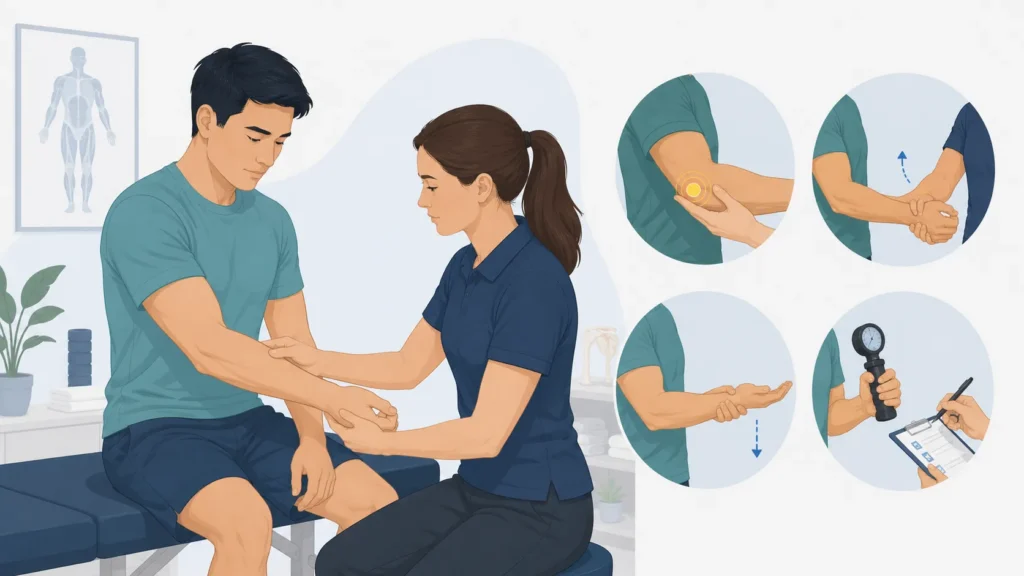
A physical therapist first asks how the symptoms started and what changed before they appeared. The discussion may include tennis or pickleball frequency, lifting volume, job tasks, computer use, equipment, sleep, previous injuries, and the timing of soreness after activity.
The therapist will ask about specific tasks rather than relying only on a general pain rating. Does gripping with the elbow straight hurt more than gripping with it bent? Is a backhand more provocative than a forehand? Does the pain increase with a heavy dumbbell, a screwdriver, or a prolonged mouse position?
The examination may include elbow, wrist, forearm, shoulder, and neck motion. Grip strength can be measured in different wrist and elbow positions to see how force and symptoms change. Resisted wrist and finger movements help assess how the forearm responds to load.
The therapist may also watch you perform a task that resembles your goal. This might include lifting a box, holding a racquet, completing a backhand motion, using a tool, or performing a work simulation. These observations help connect the examination findings to real life.
The purpose is not to identify one perfect position or blame poor form. It is to determine which factors are most likely contributing, rule out signs of another problem, and establish a starting load that can be progressed safely.
How Physical Therapy Helps Tennis Elbow
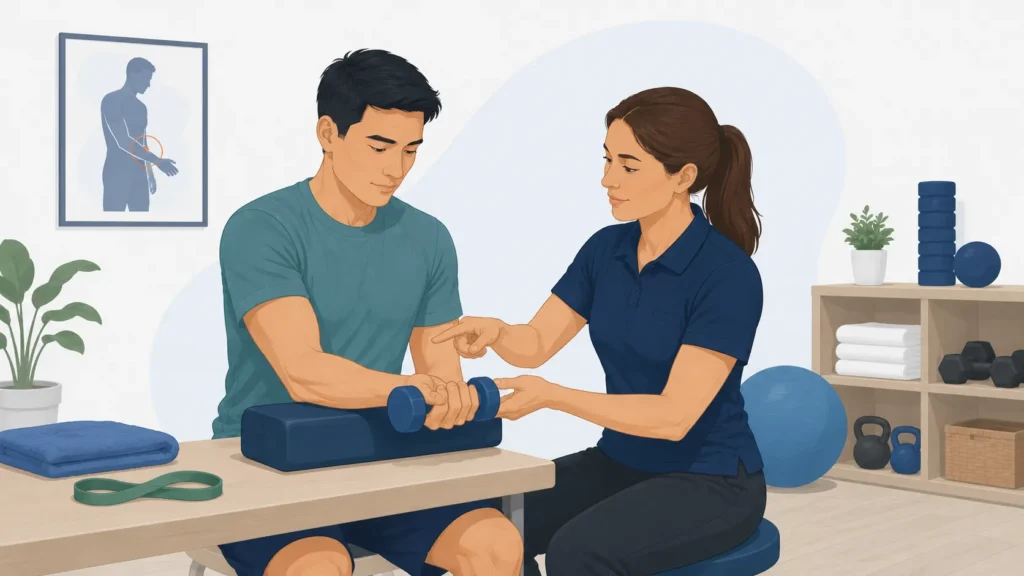
Treatment focuses on improving the arm’s capacity rather than only calming symptoms. Early on, this may involve reducing the most aggravating combination of force, repetition, speed, or duration while keeping the elbow and wrist moving in comfortable ways.
Strengthening usually progresses through the wrist, forearm, grip, shoulder, and upper body according to the person’s goals. The starting exercise may be a low-load hold or controlled wrist movement. Over time, the arm can be challenged with heavier resistance, faster movements, longer repetitions, and more specific tasks.
For example, a tennis player may begin with supported wrist extension and light gripping that does not cause a lasting increase in symptoms. The program may then progress to controlled lifting, stronger grip demands, shadow swings, groundstrokes, serves, and eventually full-speed play.
Hands-on treatment, taping, or a brace may be useful when they help someone move or exercise with less irritation. These tools are best used to support participation while the underlying strength and load tolerance improve.
Rehabilitation Progression
Rehabilitation usually moves from reducing unnecessary irritation to rebuilding the specific strength and endurance needed for work, exercise, or racquet sports. The stages overlap, and progress is guided by how the elbow responds during activity and over the following day rather than by a rigid calendar.
A person may stay at one stage for several sessions, return briefly to an earlier stage after a flare-up, or progress different activities at different rates. For example, grip strengthening may advance while serving remains temporarily limited.
| Stage | Main goal | Example focus |
|---|---|---|
| Settle irritation | Reduce unnecessary aggravation | Modify grip, lifting, racquet volume, and painful work tasks |
| Build capacity | Improve forearm and tendon tolerance | Isometric and controlled wrist and grip loading |
| Increase demand | Prepare for real activity | Heavier lifting, faster wrist movements, and longer repetitions |
| Return to activity | Restore full participation | Racquet drills, serves, backhands, work tasks, or strength training |
Progress is based on the elbow’s response, not on a fixed calendar. A person with a newer, less irritable problem may progress quickly, while symptoms that have been present for months may require a slower increase in demand.
Returning to Tennis, Work, or Exercise
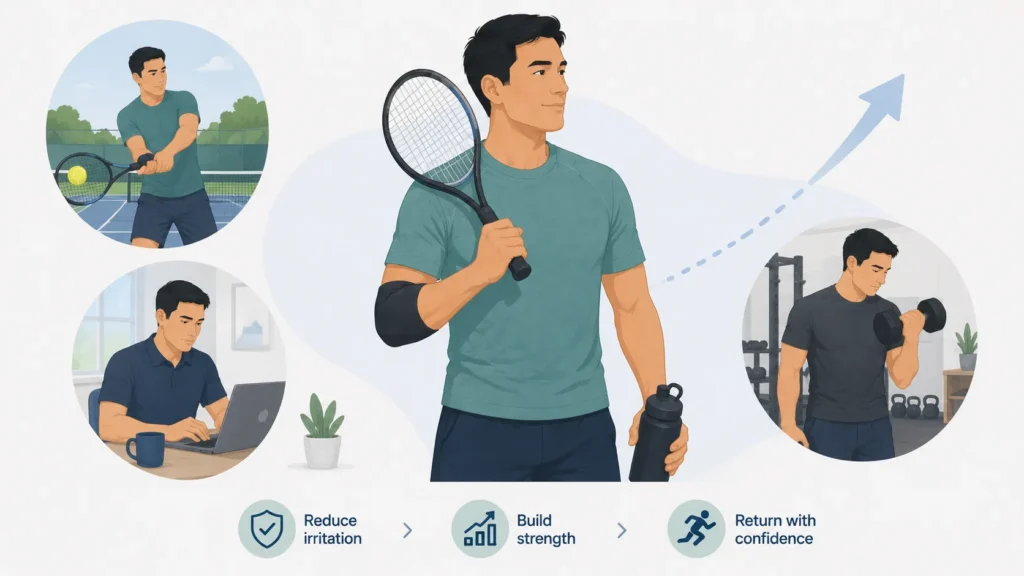
Start with a version of the activity that reduces one or more demands. You might shorten a tennis session, reduce the number of serves, use lighter resistance, take more breaks, or limit repetitive gripping at work.
Increase one variable at a time. For tennis or pickleball, you might progress from short groundstrokes to longer rallies, then add serves and higher-speed play. For lifting, you might increase resistance before adding volume, or restore volume before adding speed.
Pay attention during the session, later that day, and the following morning. A manageable response may include mild soreness that settles within a reasonable recovery period. If pain continues to build, affects your grip, or remains noticeably worse the next day, reduce the most recent increase rather than abandoning the entire program. Often, the adjustment is as simple as shortening the session, reducing repetitions, or leaving out the highest-speed or highest-force portion.
Recovery between higher-load sessions matters. Sudden spikes after travel, illness, a break from exercise, or a change in job duties are common reasons symptoms return.
How Long Does Tennis Elbow Take to Improve?
Recovery varies based on how long symptoms have been present, how irritable the elbow is, the demands of work or sport, strength, sleep, and how consistently the load is progressed.
Improvement is not measured only by whether the elbow is completely pain-free. Better grip tolerance, less soreness after activity, improved strength, and greater participation are meaningful signs that the arm is adapting.
Symptoms may fluctuate during rehabilitation without meaning the plan has failed. A persistent plateau, repeated flare-up, or new symptom pattern is a reason to reassess the diagnosis, workload, and progression.
When to See a Physical Therapist
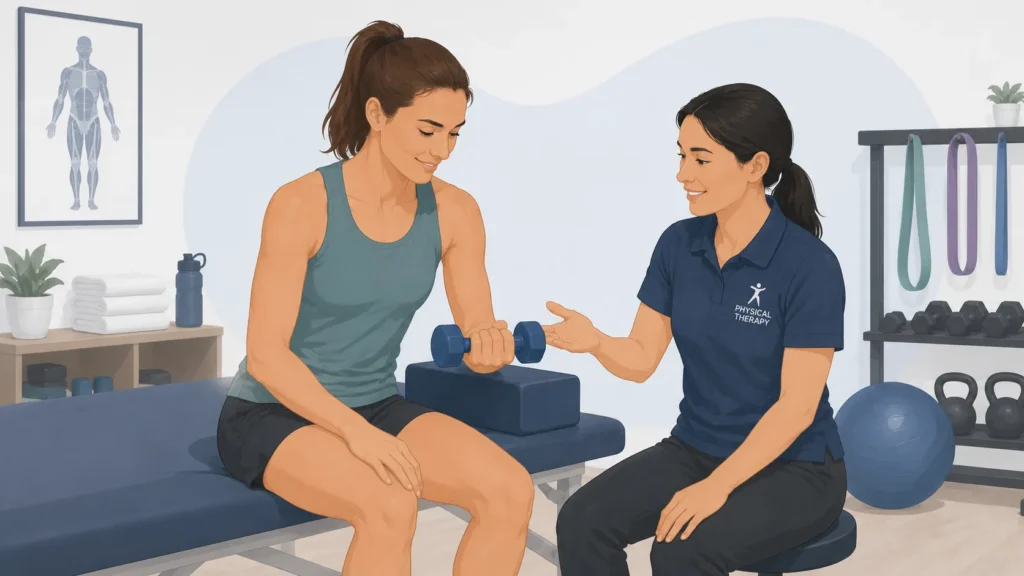
Consider an evaluation when elbow pain is limiting tennis, pickleball, work, lifting, exercise, or daily tasks. Physical therapy can also help when symptoms repeatedly return after rest or when you are unsure how to modify activity without losing all use of the arm.
An evaluation is especially useful when grip weakness, reduced motion, or pain with several different tasks is developing. Seek additional medical evaluation after significant trauma or for major swelling, a locked elbow, progressive numbness or weakness, fever, or an inability to use the arm normally.
Final Thoughts
Tennis elbow is usually related to repeated loading that exceeds the arm’s current capacity, not simply to playing tennis. It can affect racquet athletes, workers, lifters, desk workers, and active adults who have recently changed how much they use their arm.
The most useful plan balances activity modification with progressive strengthening. Tracking how the elbow responds during and after activity helps identify an appropriate starting point and guides the next progression.
A physical therapy evaluation can connect your symptoms to the movements, workload, equipment, and recovery factors that matter most in your daily life.
Get Tennis Elbow Treatment in Overland Park
If you need treatment for tennis elbow, visit Calibration Physical Therapy in Overland Park, Kansas. We can evaluate your symptoms and help you build back the strength and activity tolerance needed for work, exercise, or racquet sports. Schedule an evaluation to get started.
Tags

About the Author
Dr. Traci Smiley, DPT
Traci is a licensed physical therapist and owner of Calibration Physical Therapy, serving the Kansas City area. A Board-Certified Orthopedic Clinical Specialist with advanced training in manual therapy and strength conditioning, she helps individuals overcome pain and return to what they love.