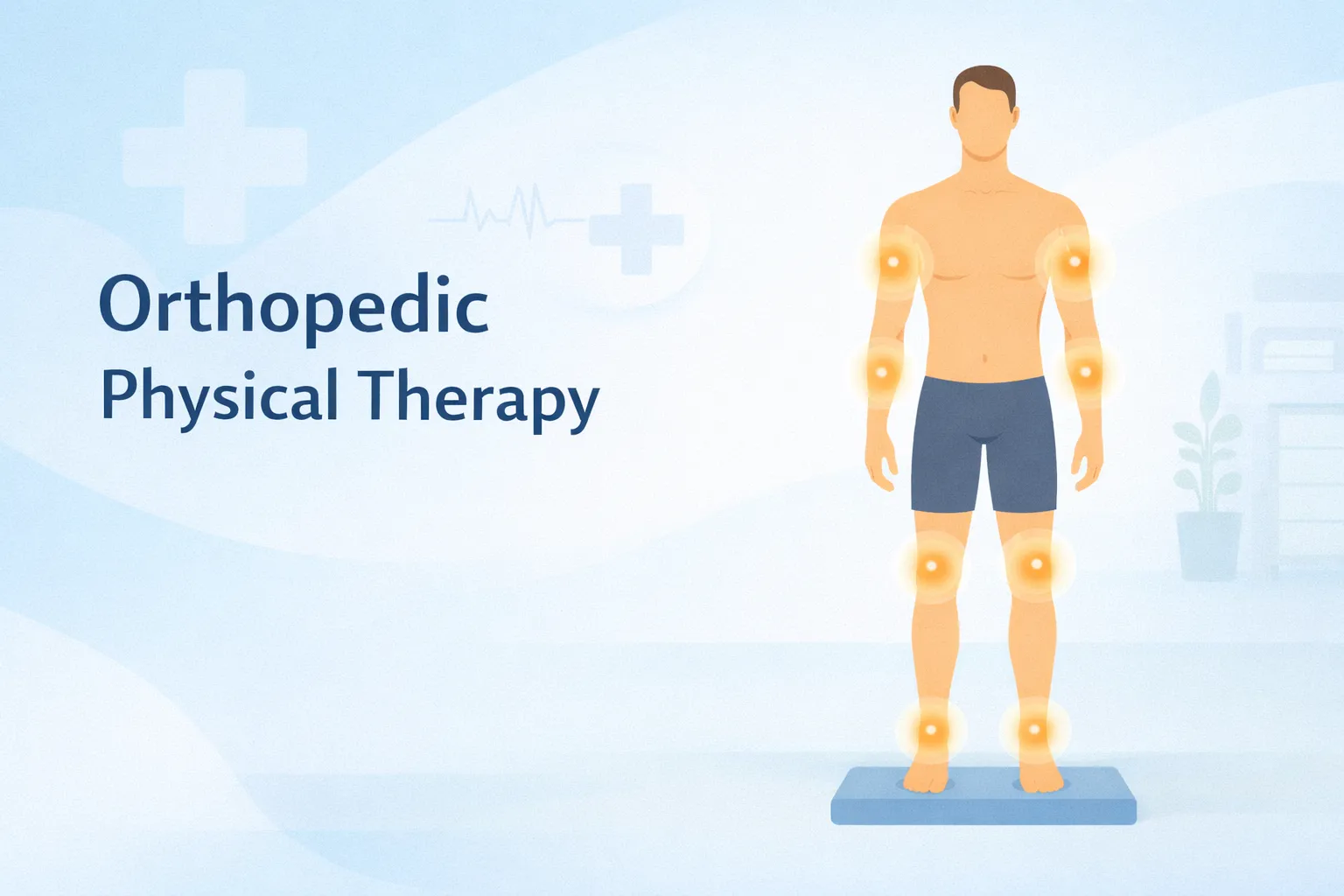
Orthopedic physical therapy treats injuries and conditions involving the muscles, joints, tendons, ligaments, and bones. These structures form the musculoskeletal system and enable the body to move, be stabilized, and withstand physical activity.
At Calibration Physical Therapy, orthopedic care is a major part of our daily work. Patients commonly visit for conditions such as knee, back, and shoulder pain, as well as sports-related injuries.
This article explains what orthopedic physical therapy is, the types of conditions it treats, and how treatment helps people return to comfortable movement.
What Is Orthopedic Physical Therapy?
Orthopedic physical therapy focuses on treating injuries and movement problems involving muscles, joints, tendons, and ligaments.
Physical therapists evaluate how the body moves and help restore strength, mobility, and activity tolerance so people can return to daily movement, exercise, and sports with less pain.
In everyday terms, orthopedic physical therapy helps restore comfortable movement when pain, injury, or physical stress interferes with normal activity.
Many patients seek care when a joint begins hurting during exercise, when back pain makes daily tasks difficult, or when an injury limits what they can do.
Orthopedic physical therapists evaluate how different parts of the body work together during movement. Rather than focusing solely on the painful area, the evaluation assesses how joints move, how muscles support them, and how the body handles load during activities such as walking, running, lifting, or reaching.
In the clinic, this often involves assessing common regions for orthopedic problems, including the knee, shoulder, hip, ankle, neck, and lower back. Pain in these areas often develops when tissues become irritated, overloaded, or unable to tolerate the demands of a person’s activity level.
The goal of orthopedic physical therapy is to improve how the body moves and gradually rebuild tolerance to activity so that everyday tasks and exercise feel easier again.
What Conditions Does Orthopedic Physical Therapy Treat?

Orthopedic physical therapy addresses a wide range of problems involving joints, muscles, tendons, and ligaments. Most people seek care when pain begins to interfere with normal activities, such as exercising, lifting, walking, or even sitting comfortably.
In the clinic, these issues usually fall into two broad patterns:
- Some patients arrive after a clear injury, such as a sprain or muscle strain during sports or physical activity.
- Others develop symptoms gradually as tissues become irritated by repeated stress or changes in activity levels.
Orthopedic conditions most often affect major joints, including the spine, shoulders, hips, knees, and ankles. Pain in these areas can make everyday tasks more difficult, including running, reaching overhead, squatting, or getting up from a chair.
Common conditions treated in orthopedic physical therapy include:
- Knee pain and patellofemoral pain
- Shoulder pain or rotator cuff irritation
- Low back pain
- Neck pain
- Tendon problems, such as Achilles or patellar tendinopathy
- Ligament sprains
- muscle strains
- Running-related injuries
- Joint stiffness or reduced mobility
- Rehabilitation after orthopedic surgery
These conditions affect people at all levels of activity. Some patients are runners or recreational athletes trying to stay active, while others simply want to move through daily life without discomfort.
Orthopedic physical therapy focuses on identifying the factors that contributed to the problem and helping the body tolerate movement again. Addressing those underlying factors often allows people to return to normal activity with less pain.
Common Causes of Orthopedic Pain
Musculoskeletal pain often develops when the body is asked to handle more physical load than it is prepared for. Sometimes this happens suddenly during an injury. In other cases, symptoms develop gradually as tissues become irritated by repeated stress.
In the clinic, orthopedic pain typically follows a few recognizable patterns. Understanding these patterns helps explain why symptoms appear and what factors may be contributing to the problem.
Sudden injury
Some orthopedic conditions begin with a clear injury event. This may happen during sports, exercise, or an unexpected movement such as a slip or fall. In these situations, tissues such as muscles, ligaments, or tendons are stressed beyond their tolerance at that moment.
Patients often remember exactly when the injury occurred. The area may feel painful, swollen, or difficult to move shortly afterward. Common examples include ankle sprains, muscle strains, or ligament injuries during athletic activity.
Repetitive stress
Not all orthopedic pain begins with a specific incident. Many conditions develop gradually when tissues are repeatedly stressed.
For example, runners may notice knee discomfort after increasing mileage. Someone who performs frequent overhead work may develop shoulder irritation. In these situations, symptoms tend to build slowly as tissues become sensitive to repeated loading.
Patients often describe this pattern as pain that appeared gradually rather than beginning with a single event.
Changes in activity level
Another common cause of orthopedic pain is a rapid change in physical activity. The body adapts well to gradual increases in activity, but sudden increases can overload muscles, tendons, or joints.
This often occurs when someone starts a new exercise routine, returns to sports after time off, or increases training intensity too quickly. Even positive changes, such as becoming more active, can trigger symptoms if the body has not yet adapted to the workload.
Movement limitations
Pain does not always originate in the same area where symptoms are felt. Sometimes the problem develops because movement is limited somewhere else in the body.
For example, reduced hip mobility can increase stress on the lower back during bending or lifting. Limited ankle motion may shift more load to the knee during running or squatting. Shoulder stiffness can also change how the arm moves during overhead activity.
Orthopedic physical therapy often focuses on identifying these movement limitations and restoring normal motion. Improving overall body movement can reduce strain on irritated tissues and help symptoms settle.
What Does Orthopedic Pain Feel Like?

Orthopedic pain often behaves differently from other types of pain. Instead of being constant, symptoms usually change depending on how the body is being used.
Many patients notice that certain movements trigger discomfort while other activities feel normal. For example, someone may feel knee pain when running but not when walking, or shoulder pain when reaching overhead but not at rest.
Symptoms may also change throughout the day. Stiffness is often worse in the morning or after prolonged sitting. Movement can sometimes improve how the area feels as the body warms up, though excessive activity may also worsen symptoms.
Patients commonly describe orthopedic pain patterns such as the following:
| Symptom pattern | How patients often describe it |
|---|---|
| Movement-related pain | Pain appears during specific activities like squatting, lifting, or reaching |
| Stiffness after rest | Joints feel tight after sitting, sleeping, or staying in one position |
| Activity soreness | Muscles or joints feel sore after exercise or physical work |
| Reduced strength | The area feels weaker or less stable than usual |
| Limited motion | Certain movements feel restricted or uncomfortable |
These patterns help physical therapists determine which tissues may be involved and how the condition responds to movement. Understanding how symptoms behave during activity is often more useful than focusing only on pain intensity.
How Orthopedic Physical Therapy Evaluation Works
An orthopedic physical therapy evaluation focuses on understanding how your body moves and how symptoms respond to activity and load. The goal is not only to identify where pain is located, but also to determine what factors may be contributing to it.
At Calibration Physical Therapy, the evaluation typically begins with a conversation about your symptoms and activity history. Patients often explain when the pain started, what movements trigger it, and how daily routines or exercise habits may have changed. These details help the therapist understand the context around the problem.
From there, the therapist observes how your body moves during common functional tasks. Many orthopedic problems become clearer when movement patterns are observed in real time. A therapist may watch how you walk, squat, bend, reach overhead, or perform other movements related to your symptoms.
Strength and joint mobility are also assessed. This helps determine whether joints are moving normally and whether certain muscles may be underperforming or compensating for other areas.
Experienced physical therapists are trained to evaluate movement patterns, joint mobility, and strength to determine what may be contributing to symptoms.
A typical orthopedic evaluation often includes several components:
| Evaluation step | What the therapist evaluates |
|---|---|
| Symptom history | When symptoms started and what activities influence them |
| Movement assessment | How joints and muscles work together during functional movement |
| Mobility testing | Whether joints move normally through their available range |
| Strength testing | Whether muscles provide adequate support and control |
The goal of the evaluation is to build a clear picture of how the body is handling movement and physical load. Once these contributing factors are understood, treatment can focus on improving movement patterns and gradually restoring tolerance to activity.
How Physical Therapy Helps Orthopedic Conditions
Orthopedic physical therapy helps the body move more comfortably and tolerate activity again. Treatment focuses on addressing mechanical factors that contribute to pain rather than solely on symptom reduction.
In many cases, pain develops when tissues are subjected to a load greater than they can handle. Physical therapy helps rebuild the body’s tolerance to movement so that everyday activities and exercise become easier again.
Improving movement quality
Many orthopedic conditions involve inefficient movement patterns. When joints are stiff or muscles are not coordinating well, certain tissues may absorb more stress than they should.
Physical therapy often begins by improving how the body moves. This may involve restoring joint mobility, improving coordination between muscle groups, and helping patients move with better control during everyday tasks.
Even small improvements in movement mechanics can reduce strain on irritated tissues.
Increasing tissue capacity
Muscles, tendons, and ligaments adapt when load is applied gradually. A key part of orthopedic rehabilitation involves rebuilding the capacity of these tissues so they can handle activity without becoming irritated.
This process typically involves progressive loading. Exercises are introduced gradually and progressively become more challenging as the body adapts.
Examples may include:
- strengthening exercises for supporting muscles
- controlled loading of tendons and connective tissue
- gradual return to activities like running or lifting
Over time, this progression helps tissues tolerate normal physical demands again.
Reducing unnecessary strain
Pain sometimes develops because one area of the body is doing more work than it should. This can happen when another joint is stiff or when certain muscles are not providing enough support.
Physical therapy helps distribute physical stress more evenly across the body. For example, improving hip strength can reduce strain on the knee during running or squatting, while improving trunk stability can better support the spine during lifting.
PT helps reduce irritation in the painful area while improving overall movement efficiency by addressing these critical factors.
Who Benefits From Orthopedic Physical Therapy?

Orthopedic physical therapy can help people across a wide range of activity levels. Some patients come in after a clear injury, while others seek care because pain is starting to interfere with exercise or daily movement.
In the clinic, many patients report that they can still function but that certain activities have become uncomfortable. Running may trigger knee pain, lifting may aggravate the shoulder, or prolonged sitting may cause back stiffness. Physical therapy helps identify why those symptoms are occurring and how to restore more comfortable movement.
People who benefit from orthopedic physical therapy include:
- Runners or active adults dealing with training-related pain
- Recreational athletes recovering from sports injuries
- People with ongoing back or neck discomfort
- Individuals returning to activity after orthopedic surgery
- People experiencing joint stiffness or mobility loss
- Workers whose jobs involve repetitive movement
Many patients simply want to stay active without worsening their pain. Orthopedic physical therapy focuses on improving movement while helping the body build long-term tolerance to activity.
Orthopedic Physical Therapy vs General Physical Therapy
All physical therapists receive training in musculoskeletal care. However, many choose to focus their clinical work on specific types of conditions. Orthopedic physical therapy focuses primarily on problems involving joints, muscles, tendons, and movement-related injuries.
In practice, orthopedic physical therapists spend much of their time helping people recover from musculoskeletal pain, sports injuries, and activity-related conditions. The focus is on evaluating movement, identifying mechanical causes of symptoms, and helping patients return safely to physical activity.
The table below highlights areas orthopedic PT addresses.
| Focus area | Orthopedic PT approach |
|---|---|
| Movement problems | Evaluates how joints and muscles work together during functional movement |
| Activity limitations | Identifies why specific movements or activities trigger symptoms |
| Strength deficits | Builds strength and endurance needed for physical demands |
| Return to activity | Helps patients gradually return to exercise, sport, or work tasks |
Orthopedic physical therapy is particularly valuable for people who want to stay active, return to sports, or move more comfortably during daily life.
When Should You See a Physical Therapist?
Many orthopedic conditions improve when the underlying movement or loading issue is addressed early. Waiting for pain to fully resolve on its own can sometimes allow contributing factors to persist, which may lead to recurring symptoms.

Physical therapists evaluate how the body handles movement and activity. An early evaluation can often identify why pain developed and what adjustments may help reduce strain on the irritated area.
People often seek care when symptoms begin interfering with exercise, work, or everyday movement. Physical therapy can help determine whether the issue is related to mobility, strength, movement mechanics, or activity load.
You may benefit from seeing a physical therapist if:
- Pain lasts longer than a few weeks
- Activity repeatedly triggers discomfort
- Movement feels stiff or restricted
- Injuries continue to return during exercise or sports
- Pain begins interfering with normal daily activity
Early evaluation often makes it easier to address contributing factors and return to comfortable movement more quickly.
How Calibration Physical Therapy Approaches Orthopedic Care
At Calibration Physical Therapy, orthopedic care focuses on understanding how each patient moves and how daily activities influence their symptoms. The goal is not simply to reduce pain, but to identify the factors that may have contributed to the problem.
During treatment, our physical therapists assess how the body handles real-world movements such as walking, lifting, running, or reaching. Improvements in mobility, strength, and coordination are introduced gradually so the body can adapt without unnecessary irritation.
Treatment plans are individualized based on each patient’s symptoms, goals, and activity level. For some people, the focus is returning to running or sports. For others, it may be restoring comfort during everyday tasks such as sitting, standing, or lifting.
If you are experiencing persistent joint pain, recurring injuries, or movement limitations, an orthopedic physical therapy evaluation can help identify potential contributors to the problem. Understanding how your body moves is often the first step toward returning to comfortable, confident movement. Book an evaluation today.
Tags

About the Author
Dr. Traci Smiley, DPT
Traci is a licensed physical therapist and owner of Calibration Physical Therapy, serving the Kansas City area. A Board-Certified Orthopedic Clinical Specialist with advanced training in manual therapy and strength conditioning, she helps individuals overcome pain and return to what they love.