Pain at the back of the ankle can make familiar activities feel surprisingly difficult. Walking uphill, climbing stairs, running, jumping, or pushing off during sports may bring on symptoms. Some people notice stiffness with their first steps in the morning, while others feel fine until later in the day or the morning after exercise.
Achilles tendonitis, also called Achilles tendinopathy, develops when the tendon is not currently tolerating the amount or type of load being placed on it. The tendon connects the calf muscles to the heel and helps transfer force during push-off, so it works hard during running, jumping, and changes of direction.
Symptoms often follow a change in training or daily activity. A runner may add hills or speed work, an adult may return to basketball after time away, or someone may suddenly increase walking at work. The tendon can become sensitive when demands rise faster than the body can adapt.
This article explains what contributes to Achilles tendonitis, how symptoms behave during activity, common mistakes that slow progress, and how physical therapy can help you return to the activities that matter to you.
Quick Answer
Achilles tendonitis usually develops when the tendon is exposed to more force, repetition, or intensity than it can currently manage. Pain may occur with running, jumping, walking uphill, or repeated push-off, and stiffness may be noticeable after rest or the following morning.
Recovery usually involves modifying the most aggravating load without stopping all movement, then gradually rebuilding calf and tendon capacity. Physical therapy helps identify the loads driving symptoms and creates a progression toward running, sports, work, or exercise.
What Causes Achilles Tendonitis?
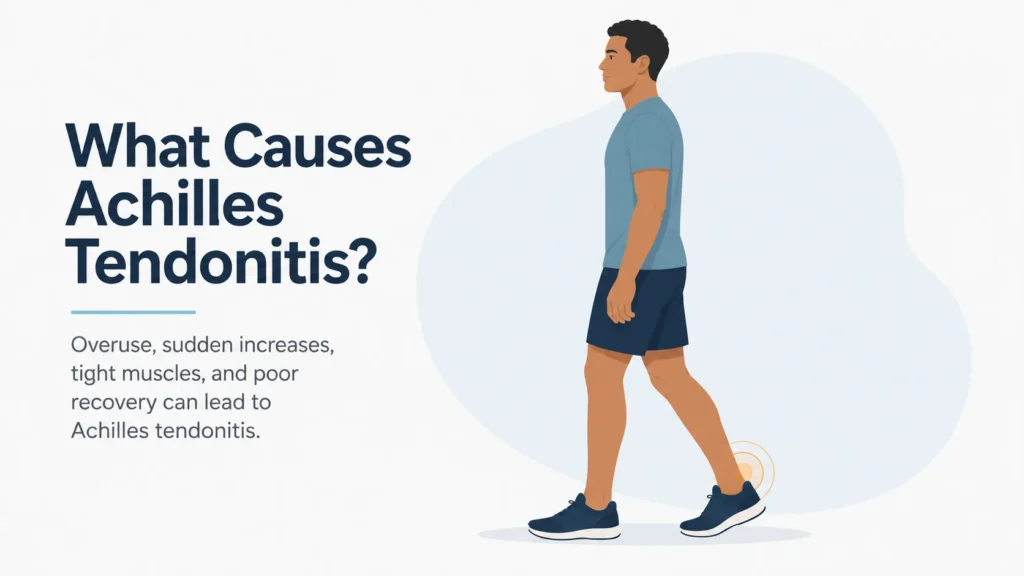
The Achilles tendon is built to handle substantial force. During running and jumping, it stores and releases energy as the ankle moves through the push-off phase. Symptoms can develop when repeated stress exceeds the tendon’s current ability to recover and adapt.
A sudden change in workload is a frequent contributor. This might be more running mileage, hill repeats, sprint intervals, a new fitness class, or a return to court sports. Changes in speed, surface, footwear, frequency, or intensity can alter the tendon’s demands even when weekly mileage stays the same.
Calf strength and ankle motion also influence how force is shared through the lower leg. If the calf fatigues quickly, the tendon may carry more of the work during repeated push-off. Limited ankle motion may change how someone lands, squats, runs, or climbs stairs.
Recovery is part of the loading equation. Sleep, stress, work demands, nutrition, and the spacing between hard sessions can affect how the tendon responds. Achilles pain is often related to the relationship between activity and recovery rather than to a single isolated mistake.
What Does Achilles Tendonitis Feel Like?
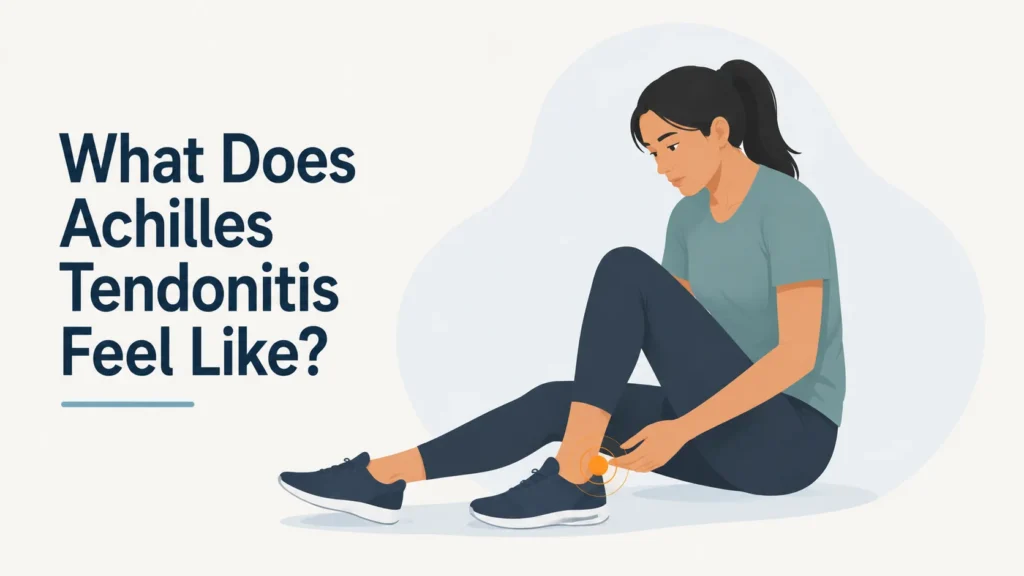
Pain is usually felt at the back of the ankle, either close to the heel or higher along the tendon. The area may feel tender, thick, tight, or sensitive when touched. Some people describe pulling during push-off, while others feel a sharper increase in pain with faster movement.
Morning stiffness is common. The first several steps may be uncomfortable before the ankle loosens with movement. Similar stiffness can occur after sitting for a long time, riding in a car, or finishing a workout.
Symptoms may appear during activity, afterward, or the next day. Someone may complete an easy run with mild discomfort but notice more stiffness the following morning. That delayed response helps show whether the total workload was appropriate.
The tendon may also respond differently to different tasks. Level walking may be manageable, while hills are painful. Slow jogging may be acceptable, while sprinting, jumping, or cutting is not. These differences provide useful information about which demands currently exceed the tendon’s capacity.
How Symptoms Behave During Activity
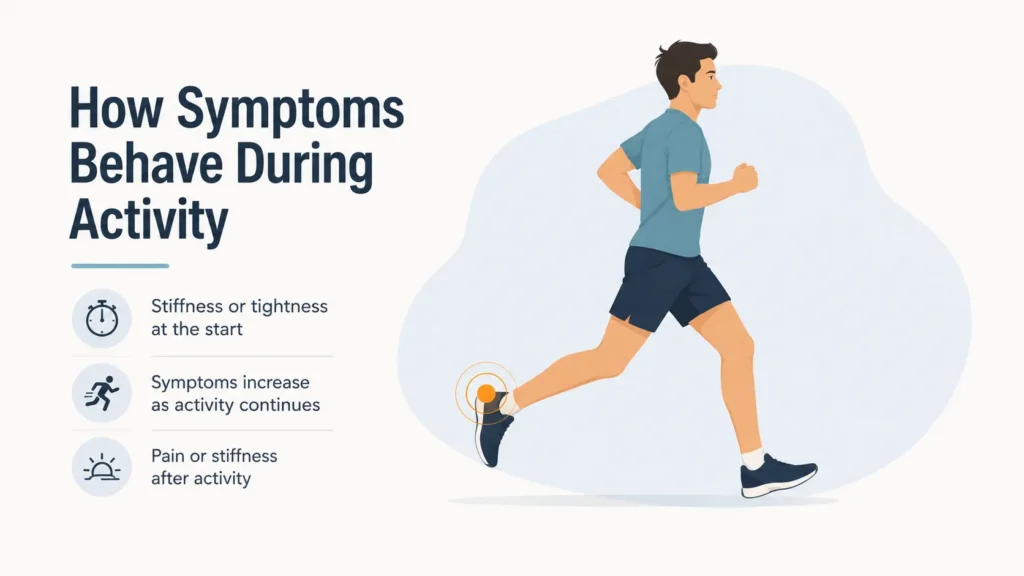
Achilles symptoms generally increase as the calf has to produce more force or repeat that force more often. Running faster, running uphill, jumping, pushing off to change direction, and performing repeated heel raises all increase demand.
Pain during activity does not automatically mean that the tendon is being damaged. A mild, stable level of discomfort may be acceptable if it does not affect movement and settles within a reasonable period. Pain that steadily builds, causes limping, or changes your stride suggests that the current load is too high.
The response later that day and the next morning often matters more than a single moment during a workout. If morning stiffness is clearly worse or lasts much longer than usual, the next session may need less volume, lower intensity, or more recovery time.
Use your normal symptoms as a baseline. If the tendon is usually stiff for five minutes but is uncomfortable for thirty minutes after a workout, that is a meaningful change. It does not necessarily mean you need complete rest. It means the next training decision should account for the delayed response.
Common Mistakes People Make When Symptoms Start
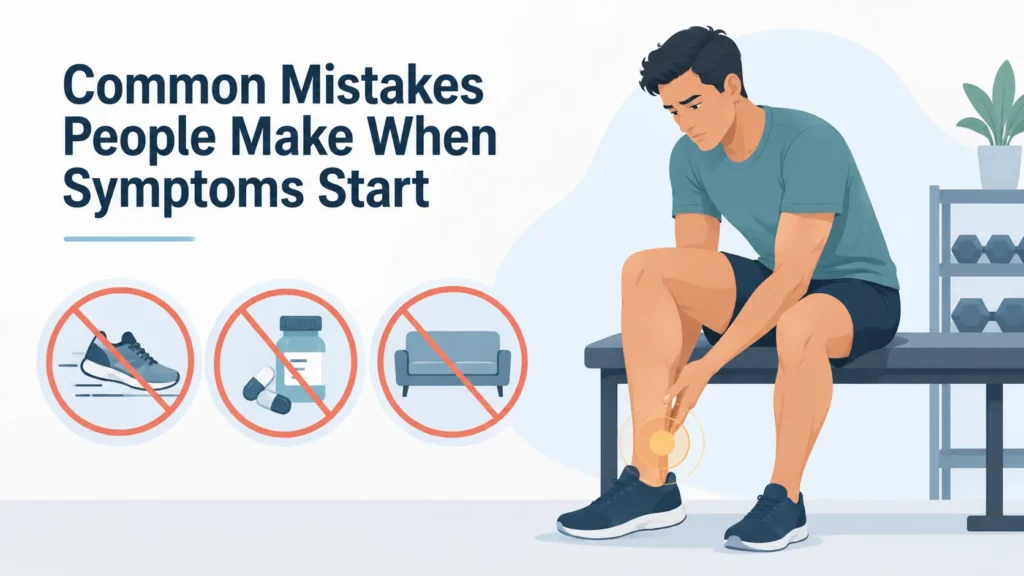
Ignoring symptoms until they become severe is a common problem. Someone may continue the same running plan, add stretching, and hope the discomfort disappears. By the time activity is significantly limited, it can be harder to determine which load started the problem.
Complete rest can also create difficulty. Rest may temporarily reduce symptoms, but the tendon still requires progressive loading to regain capacity. Avoiding all movement leaves the tendon unprepared for the demands of returning to exercise.
Another mistake is changing everything at once. Stopping running, beginning aggressive stretching, buying new shoes, and starting a demanding exercise program makes it difficult to know what helped or what increased irritation.
Aggressive calf stretching can be irritating, particularly when the pain is near the heel. Stretching places the tendon in a lengthened, sometimes compressed, position. It may become useful later, but it should match the tendon’s current tolerance.
Finally, people often progress based on how the tendon feels during one good workout. A good day does not always mean the tendon is ready for a major increase in distance, speed, hills, or jumping.
Why Symptoms Often Develop Gradually
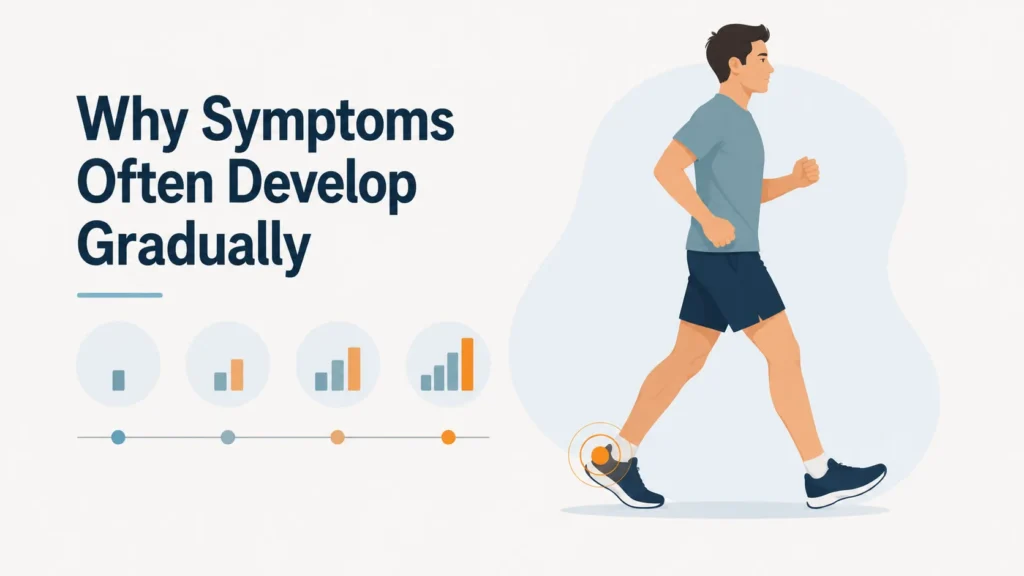
Achilles tendonitis commonly develops over several days or weeks as the tendon responds to repeated exposure. The initial change may be small, such as one extra run, a few hill repeats, or a weekend tournament. Repeated exposure without enough recovery can gradually increase sensitivity.
There may be no single moment that feels like an injury. Instead, warm-up takes longer, morning stiffness becomes more noticeable, or activities that were previously easy become less comfortable.
Daily life adds to the total load. Standing for long periods, walking more at work, climbing ladders, or changing footwear can increase demand on the calf and tendon. The body responds to the combined load of exercise and daily life, not just the formal workout.
Achilles Tendonitis vs. Plantar Fasciitis
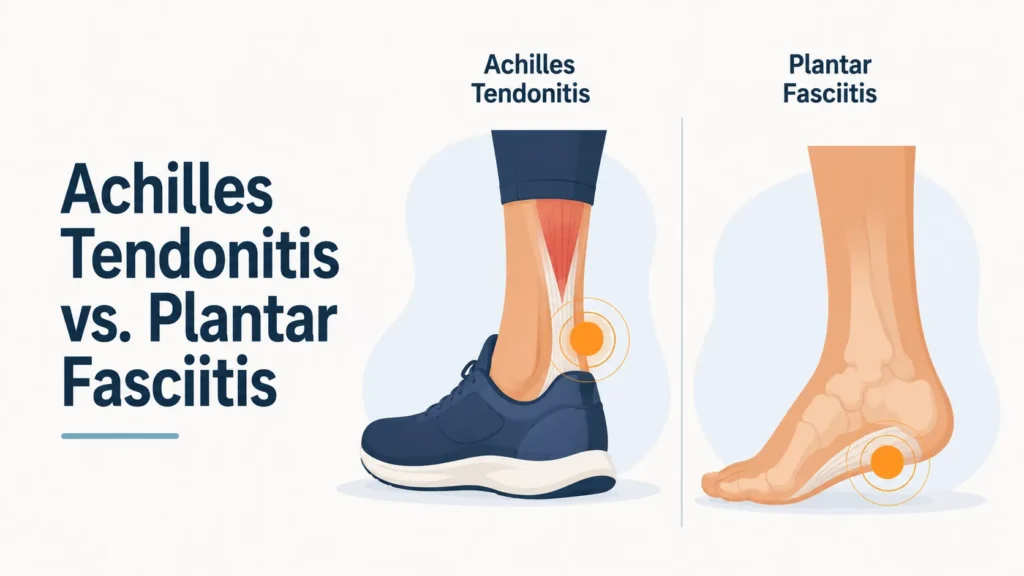
Both conditions can cause heel pain, but the location is often different. Achilles pain is usually at the back of the ankle or above the heel. Plantar fasciitis more often causes pain along the bottom of the heel or the arch.
Both may be worse with the first steps after rest. Achilles tendonitis often feels like stiffness as the ankle begins moving, while plantar fasciitis may cause sharper pain under the heel. Since walking and running can aggravate both, location and movement testing help clarify the pattern.
Pain near the back of the ankle can also come from a calf strain, irritation of a nearby bursa, or a more significant tendon injury. An evaluation can help determine whether the symptoms are consistent with gradual tendon overload or require another type of care.
How Physical Therapy Evaluates Achilles Tendonitis
A physical therapy evaluation begins with the story of how symptoms developed. The therapist will ask about recent changes in running, sports, lifting, work, footwear, hills, surfaces, and recovery. The timing of pain during activity and the next morning helps show how the tendon responds to load.
The therapist may observe walking, squatting, stepping down, single-leg balance, and heel raises. Calf strength, ankle motion, foot control, tendon tenderness, and the ability to produce force without compensation are also relevant.
For a runner or athlete, the evaluation may include hopping, landing, or running mechanics when appropriate.
How Physical Therapy Helps Achilles Tendonitis
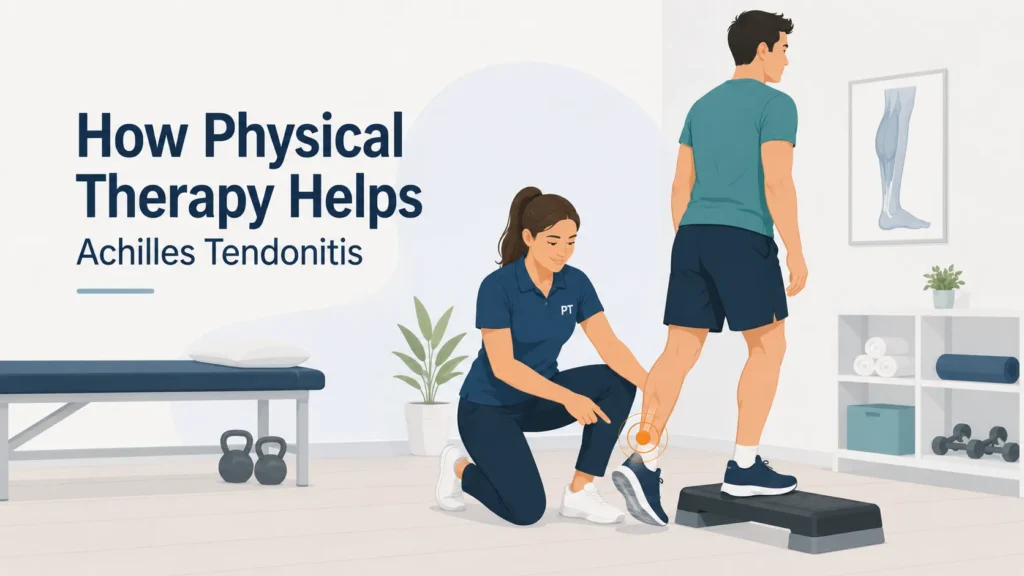
Physical therapy matches the tendon’s current capacity with a tolerable level of stress. Early changes may include reducing hill work, replacing sprinting with easy cycling, shortening a run, or spacing hard sessions farther apart.
Strengthening rebuilds the calf and tendon’s ability to handle force. Treatment may begin with controlled heel raises or isometric holds and progress toward heavier resistance, single-leg work, hopping, and sport-specific drills.
The progression should reflect the person’s goals. A runner may move from calf strengthening to run-walk intervals and then faster running. A tennis player may progress toward lateral pushes, acceleration, and deceleration. Someone limited at work may need tolerance for prolonged standing, stairs, or lifting.
Hands-on treatment, taping, footwear changes, or a temporary heel lift may reduce symptoms enough to make movement easier. These tools can be useful, but the lasting goal is improved strength and load tolerance.
Rehabilitation Progression
Rehabilitation is not a fixed list of exercises. It is a gradual change in the type, amount, and speed of loading the Achilles tendon can handle. The right progression depends on your symptoms, strength, daily demands, and end goal.
| Stage | Primary goal | What it may include | Typical reason to progress |
|---|---|---|---|
| 1. Calm symptoms and maintain movement | Keep the ankle active without creating a lasting flare-up | Isometric calf holds, controlled heel raises, level walking, and cycling | Symptoms remain stable during activity and are close to baseline the next morning |
| 2. Build strength | Increase the force the calf and tendon can produce | Heavier calf raises, single-leg work, slow lowering, bent-knee calf work | Strength work is controlled and recovery is predictable between sessions |
| 3. Build energy storage | Prepare the tendon for faster, spring-like loading | Skipping, hopping, landing drills, jumping, short accelerations | You can absorb and produce force without limping or losing control |
| 4. Return to training or sport | Match the demands of your activity | Run-walk intervals, hills, cutting, repeated efforts, sport drills | The tendon tolerates the required volume, speed, and recovery pattern |
What Progression Looks Like in Practice
A runner may begin with controlled calf strengthening and easy walking, then add short run-walk intervals on level ground. Hills and faster running come later because they increase the force and energy demands on the tendon. A tennis player may first work on calf strength, then add low-level hopping, followed by lateral movement, acceleration, and deceleration.
Progress is based on the tendon’s response, not simply on completing a certain number of repetitions. Before moving forward, look for manageable symptoms during the session, no meaningful change in walking or running mechanics, and morning stiffness that returns to its usual baseline within a reasonable period.
A temporary step back is part of the process. If jumping causes a clear increase in next-day stiffness, return to the last stage that was well tolerated, reduce the volume, and try again after recovery. This is a workload adjustment, not a failure of rehabilitation.
Returning to Activity
Change one training variable at a time. A runner may first increase easy running time, then add distance, and later reintroduce hills or speed. An athlete may begin with controlled drills before returning to full practices or competition.
Use the following questions after a training session:
- Did pain stay stable, or did it steadily build?
- Did you change your walking, running, landing, or push-off mechanics?
- Was morning stiffness noticeably worse the next day?
- Did you have enough recovery before the next demanding session?
Stable, manageable discomfort may be acceptable. Worsening pain, altered movement, or increased next-morning stiffness suggests that the workload should be adjusted.
Recovery between sessions matters. Hard running, jumping, and court sports may require more time between sessions than walking or strength training. Avoid sudden spikes in training volume, intensity, or frequency.
A return to full activity does not require the tendon to feel perfect every minute. It requires manageable symptoms, improved strength, normal or near-normal movement, and the ability to tolerate the activity without repeated delayed flare-ups.
When to See a Physical Therapist
Consider an evaluation if Achilles pain is limiting running, walking, stairs, work, or exercise, or if symptoms continue for several weeks and keep returning after activity changes.
A physical therapist can also help when you are unsure how much activity to continue. The evaluation can distinguish a manageable training response from a pattern showing that the current load is too high.
Seek prompt medical attention after a sudden pop, immediate loss of push-off strength, significant swelling or bruising, or difficulty walking after an acute injury. Those signs may indicate a more serious tendon injury than gradual Achilles tendonitis.
Final Thoughts
Achilles tendonitis usually reflects a mismatch between the tendon’s current capacity and the demands placed on it. Changes in distance, speed, hills, jumping, footwear, work, and recovery can all contribute.
The most useful approach is usually a thoughtful adjustment of the activity followed by progressive strengthening. Complete rest may not prepare the tendon for return, while repeatedly pushing through worsening symptoms can keep it irritated.
Track how the tendon responds during activity and the next morning. That information, combined with a specific evaluation, can guide a gradual return and reduce the risk of repeated restarts.
When Achilles Pain Keeps Limiting Your Activity
If Achilles pain is affecting your running, workouts, sports, or daily routine, Calibration Physical Therapy can help identify the factors driving symptoms and build a practical path back to activity. Calibration Physical Therapy in Overland Park, Kansas, works with active adults and recreational athletes through individualized evaluation and progressive rehabilitation. Book an evaluation to get started.
Tags

About the Author
Dr. Traci Smiley, DPT
Traci is a licensed physical therapist and owner of Calibration Physical Therapy, serving the Kansas City area. A Board-Certified Orthopedic Clinical Specialist with advanced training in manual therapy and strength conditioning, she helps individuals overcome pain and return to what they love.