Shoulder pain when lifting the arm is a common problem for active adults. Many people notice discomfort when reaching into cabinets, putting on a shirt, lifting weights, or raising their arm to grab something from a shelf.
In many cases, the shoulder itself is not damaged. The pain often develops because the joint becomes sensitive to certain movements or loads over time.
This article explains why shoulder pain happens during arm lifting, how symptoms typically behave, and how physical therapy helps restore comfortable movement.
Why Shoulder Pain Happens When You Lift Your Arm
The shoulder is designed to move through a very large range of motion. It allows the arm to reach overhead, rotate, push, pull, and stabilize objects during daily activity. Because the joint prioritizes mobility, it relies heavily on muscles and coordinated movement to stay comfortable and stable.
When those muscles do not work together smoothly, certain movements can put extra strain on sensitive tissues. This often shows up when lifting the arm overhead, especially during repeated reaching or exercise.
Many people notice pain only during a specific part of the movement. The arm may feel comfortable at the start, but become painful as it approaches shoulder height. Others notice pain while lowering the arm, or when repeating the motion several times.
These movement patterns often point to a shoulder that has become irritated or overloaded rather than a single traumatic injury.
What Causes Shoulder Pain When Lifting the Arm?

Shoulder pain when lifting the arm is usually caused by irritation of the rotator cuff muscles or surrounding shoulder structures during overhead movement.
This often happens when the shoulder becomes sensitive to load or when the muscles that guide the joint are not working together smoothly.
Common causes include rotator cuff irritation, reduced shoulder mobility, problems with shoulder blade movement, or a sudden increase in activity or exercise.
Shoulder pain physical therapy focuses on identifying how the shoulder moves during lifting and restoring strength and coordination so the joint can tolerate activity comfortably again.
What Structures Are Usually Involved?
Several structures work together to guide the shoulder during arm elevation. When one of them becomes irritated or fatigued, lifting the arm can become uncomfortable.
Several structures can contribute to shoulder pain during arm lifting. The most common include:
- Rotator cuff tendons
- The subacromial space above the shoulder joint
- The biceps tendon at the front of the shoulder
- Shoulder blade stabilizing muscles
- The joint capsule and surrounding soft tissue
The rotator cuff plays a major role during arm lifting. These muscles stabilize the shoulder joint and guide the ball of the shoulder as the arm moves overhead. If the rotator cuff becomes irritated or weak, the shoulder can become sensitive during repeated movement.
The shoulder blade is equally important. It must rotate and tilt in coordination with the arm so the joint moves smoothly. When that coordination is limited, the shoulder joint may experience extra pressure during overhead motion.
What Does Shoulder Pain With Arm Lifting Feel Like?
Shoulder pain during arm lifting often follows recognizable patterns. Experienced physical therapists use these symptom patterns to understand how the shoulder is behaving during movement.
| Symptom pattern | What patients notice |
|---|---|
| Pain during lifting | Discomfort when raising the arm overhead |
| Painful arc | Pain between shoulder height and overhead |
| Weakness feeling | The arm feels heavy or harder to lift |
| Ache after activity | Shoulder soreness later in the day |
Pain is often felt on the outside of the shoulder or along the upper arm. Some patients describe the sensation as a pinch or pressure during overhead movement.
Others notice stiffness in the morning or after prolonged sitting. When the shoulder warms up, the arm may move more easily.
Night discomfort can also occur. Lying on the affected shoulder may increase pressure on sensitive tissues, leading to shoulder pain.
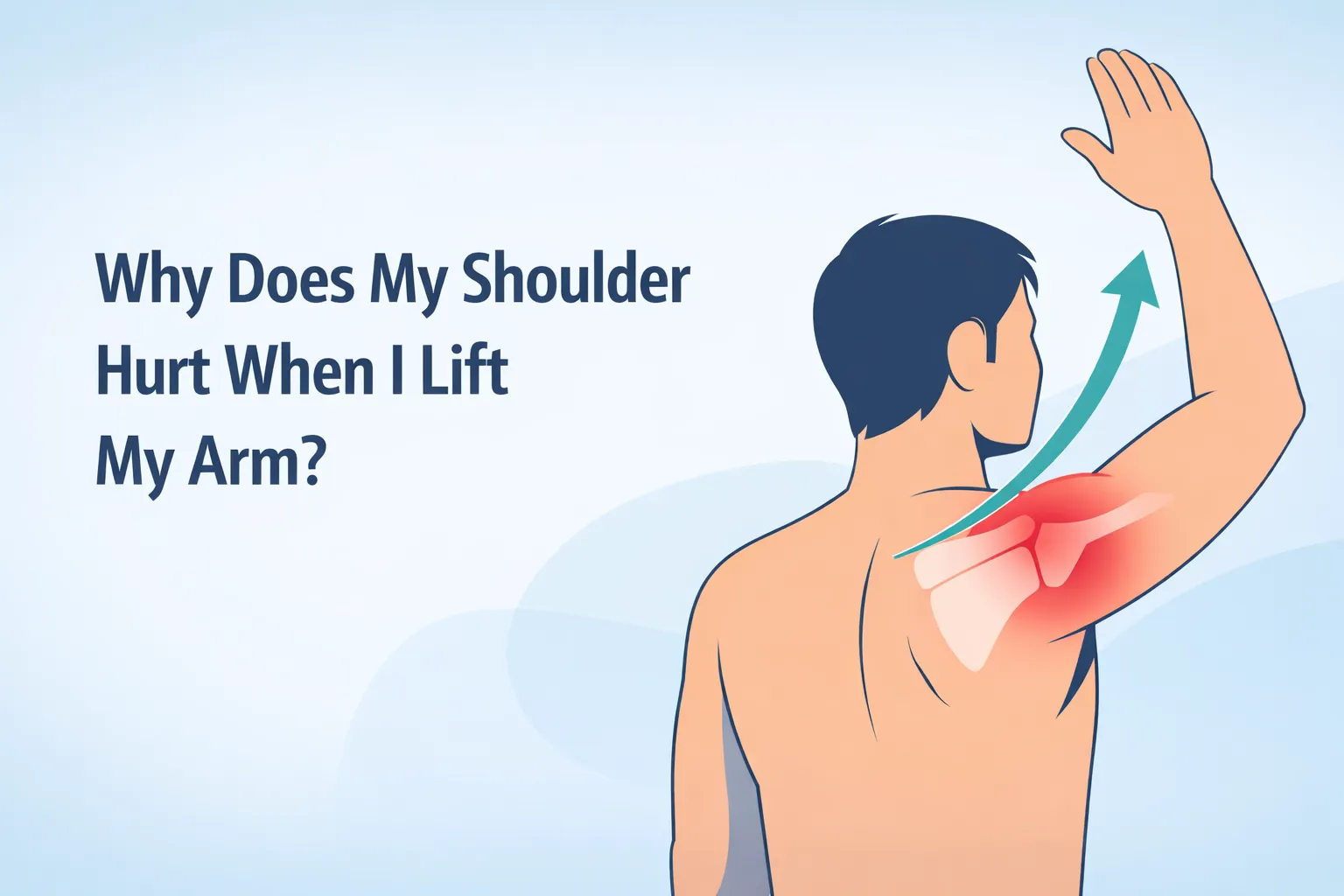
Why Does My Shoulder Hurt Between Shoulder Height and Overhead?
Many patients notice that shoulder pain does not occur during the entire arm movement. Instead, the pain often appears in a specific portion of the motion.
A common pattern is discomfort when the arm moves between shoulder height and overhead. Physical therapists often refer to this as a “painful arc.”
During this part of the movement, the rotator cuff muscles guide the shoulder joint while the shoulder blade rotates upward. If these muscles become irritated or fatigued, this portion of the motion can become sensitive.
People often describe the pain as a pinch or pressure on the outside of the shoulder. Once the arm moves fully overhead, the discomfort may decrease again.
This pattern can provide useful information during a physical therapy evaluation. It often suggests that the shoulder is irritated during movement rather than structurally damaged.
Improving shoulder blade movement, rotator cuff strength, and mobility often reduces this type of symptom over time.
Shoulder Impingement vs Rotator Cuff Pain
When people search online about shoulder pain during arm lifting, they often encounter terms like “shoulder impingement” or “rotator cuff injury.” In many cases, these terms describe similar movement problems rather than completely separate diagnoses.
The term “shoulder impingement” is often used when tissues in the shoulder become irritated during arm elevation. This can happen when the shoulder blade does not rotate well or when the rotator cuff muscles are not controlling the joint effectively.
The rotator cuff muscles guide the shoulder joint during arm elevation. If these muscles become irritated or fatigued, the shoulder may become sensitive during overhead movement.
Both situations usually respond well to physical therapy that focuses on improving movement and strength.
Rather than focusing only on labels, physical therapists evaluate how the shoulder behaves during motion. Understanding movement patterns often provides more useful information than the diagnosis name alone.
Can I Keep Exercising With Shoulder Pain?
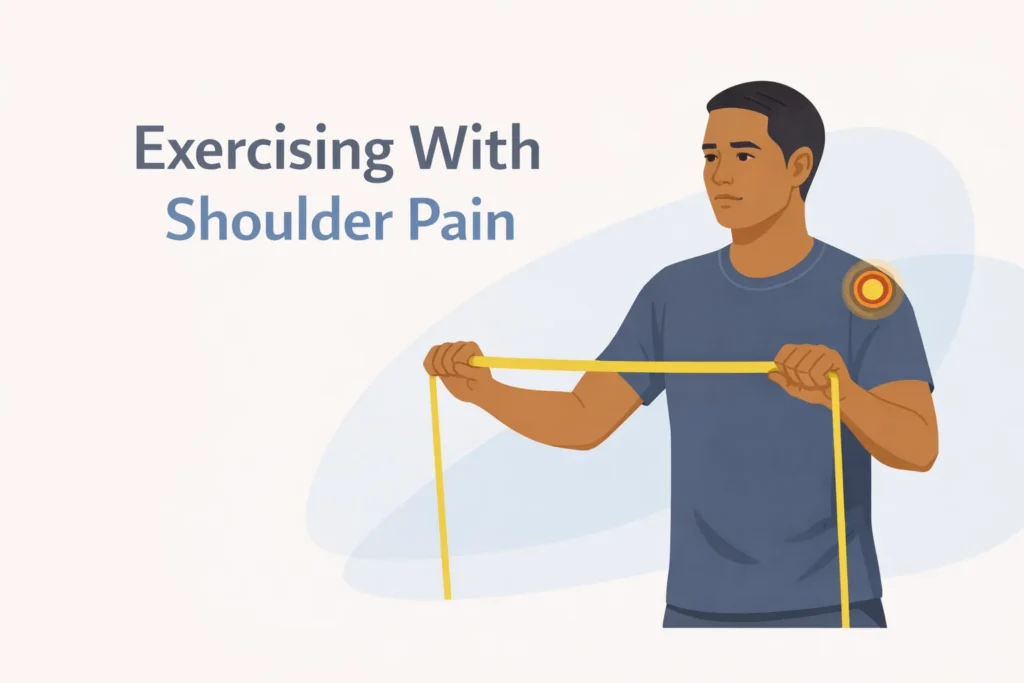
Many active adults worry that shoulder pain means they must stop exercising completely. In most cases, that is not necessary.
The shoulder often tolerates controlled movement better than complete rest. The key is to adjust the activity so the joint is not repeatedly irritated.
Some people benefit from temporarily modifying certain movements. For example, overhead pressing or heavy lifting may need to be reduced while the shoulder calms down.
Many people can continue other forms of exercise without aggravating the shoulder, such as:
- Lower body strength training
- Walking or running
- Core training
- Light pulling or rowing movements
- Controlled shoulder mobility work
As symptoms improve, activity can gradually increase again. The goal is to rebuild the shoulder’s tolerance to load rather than avoiding movement entirely.
A physical therapist can help determine which movements are safe to continue and which should be temporarily modified.
How Shoulder Pain Behaves During Daily Activity
Shoulder pain is rarely constant throughout the day. Instead, symptoms usually appear during certain movements or activities that load the joint.
People commonly notice discomfort during activities such as:
- Reaching into cabinets
- Putting on a shirt or jacket
- Lifting objects overhead
- Carrying groceries
- Sleeping on the affected side
- Throwing or serving during sports
For people who work at a desk, symptoms sometimes develop gradually during the day. Long periods of sitting can lead to stiffness in the upper back and shoulders, which may make overhead movement more sensitive.
Active adults often notice symptoms during exercise. Overhead pressing, push-ups, swimming, and throwing motions can all place demand on the shoulder muscles.
In many cases, the shoulder feels worse after repeated activity rather than during the first few movements. This pattern often suggests the tissues are becoming irritated by load rather than injured by a single motion.
Common Causes of Shoulder Pain During Arm Lifting
Shoulder pain during arm lifting usually develops gradually. Instead of a single injury, the problem often begins when the shoulder is asked to handle a load it is not prepared to handle.
Several factors can contribute to this type of irritation.
Common causes include:
- Repetitive overhead activity
- Sudden increases in lifting or training volume
- Rotator cuff irritation or tendinopathy
- Reduced shoulder or upper back mobility
- Weakness in the shoulder blade muscles
- Returning to activity after a period of inactivity
For example, someone returning to the gym after a long break may resume overhead lifting before the shoulder muscles have regained endurance.
Similarly, people who start a new strength program may notice shoulder discomfort if the rotator cuff and upper back muscles are not ready for the increased workload.
Movement coordination can also play a role. If the shoulder blade does not rotate well during arm elevation, the shoulder joint may experience increased pressure during overhead movement.
How Physical Therapists Evaluate Shoulder Pain
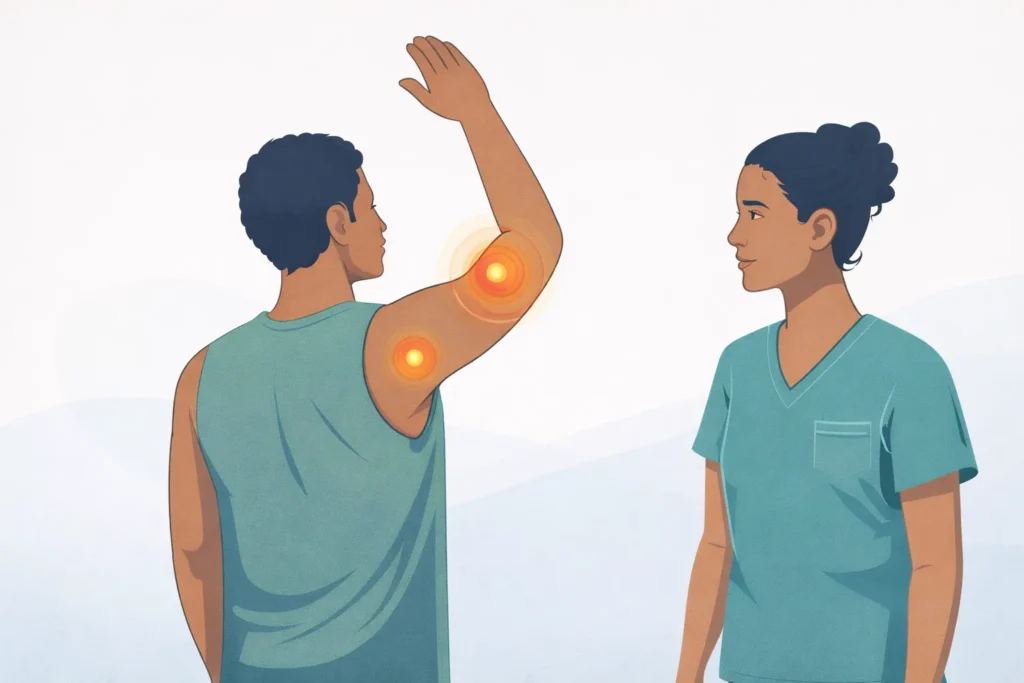
A physical therapy evaluation focuses on how the shoulder behaves during movement. Instead of relying only on imaging, therapists examine how symptoms respond to different positions and activities.
During an evaluation, a physical therapist typically looks at several key movement factors:
- How the arm moves during overhead lifting
- Shoulder blade motion during reaching
- Rotator cuff strength and endurance
- Mobility of the shoulder joint
- Movement patterns during functional tasks
Simple movement tests often provide valuable information. For example, a therapist may observe whether adjusting the position of the shoulder blades changes the pain during arm lifting.
If symptoms improve with better movement mechanics, it suggests the issue is related to coordination and load tolerance rather than structural damage.
Functional movements such as reaching, pushing, or lifting are also examined. These tasks help therapists understand how the shoulder behaves during everyday activity.
How Physical Therapy Treats Shoulder Pain
Physical therapy focuses on restoring comfortable movement and improving the shoulder’s tolerance for activity.
The goal is not simply to reduce pain. Treatment aims to address the movement and loading factors that initially irritated the shoulder.
Early treatment often focuses on calming down irritated tissue. This may involve temporarily modifying aggravating movements while keeping the shoulder within comfortable ranges of motion.
Mobility is also addressed. Many patients develop stiffness in the shoulder joint or upper back, which can affect how the arm moves overhead. Improving mobility often allows the shoulder to move with less irritation.
Strength and coordination are other important parts of rehabilitation. The rotator cuff and shoulder blade muscles guide the arm during lifting and reaching.
Common rehabilitation goals include:
- Restoring smooth arm elevation
- Improving shoulder blade coordination
- Strengthening rotator cuff support
- Improving upper back mobility
- Gradually increasing load tolerance
As symptoms improve, therapy progresses toward more functional activity. Patients often work toward returning to gym exercise, overhead lifting, recreational sports, or other activities that require shoulder strength.
How Long Does Recovery Take?

Recovery timelines vary depending on how long the shoulder has been irritated and how sensitive the joint has become.
Some mild cases improve within a few weeks once activity is adjusted and the shoulder begins moving more comfortably.
When symptoms have been present for several months, recovery may take longer. The shoulder may need time to rebuild strength and tolerance to repeated movement.
Progress usually happens gradually. Many patients notice that the painful portion of the movement decreases over time and that daily activities become easier.
Consistent movement and gradual loading are key parts of recovery.
When Should You See a Physical Therapist?
If shoulder pain during arm lifting continues for several weeks or interferes with daily activity, it may be helpful to have the shoulder evaluated.
A physical therapist can assess shoulder movement and identify which movements contribute to symptoms.
You may benefit from an evaluation if you notice:
- Persistent pain when lifting the arm
- Difficulty reaching overhead
- Shoulder pain that limits exercise or sports
- Night pain when lying on the shoulder
- Symptoms that are not improving with rest
Early evaluation often helps people return to activity sooner by identifying movement issues before they become more limiting.
Getting Help for Shoulder Pain

Shoulder pain during arm lifting can make everyday tasks difficult, but it is often very treatable with the right movement approach. In many cases, symptoms improve once the shoulder begins moving better and the supporting muscles regain their strength and coordination.
At Calibration Physical Therapy in Overland Park, treatment begins with a detailed movement assessment. Understanding how the shoulder behaves during activity helps identify the true source of symptoms.
From there, therapy focuses on restoring comfortable motion, improving strength, and helping patients return to the activities they enjoy.
Tags

About the Author
Dr. Traci Smiley, DPT
Traci is a licensed physical therapist and owner of Calibration Physical Therapy, serving the Kansas City area. A Board-Certified Orthopedic Clinical Specialist with advanced training in manual therapy and strength conditioning, she helps individuals overcome pain and return to what they love.