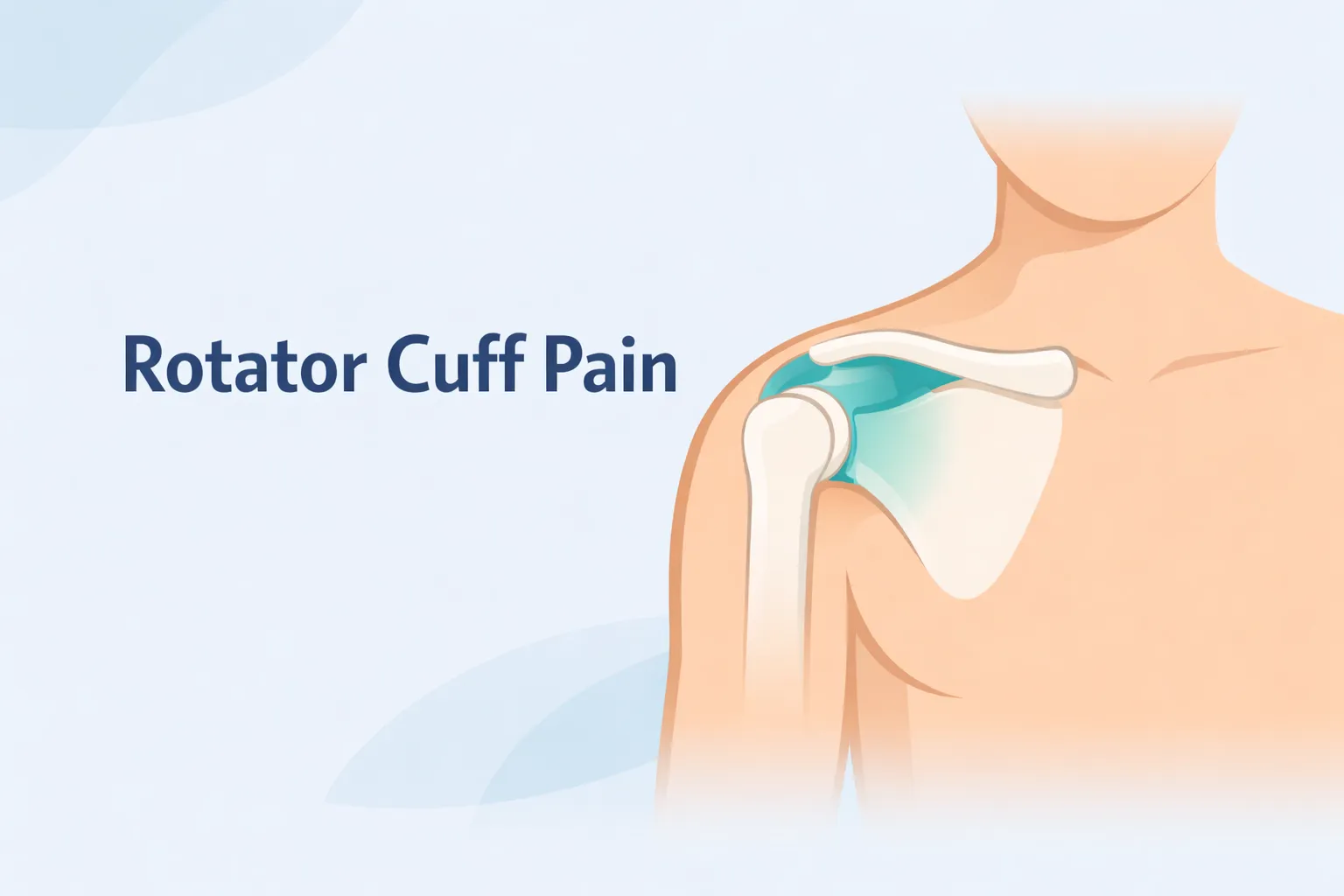
Rotator cuff pain is a common cause of shoulder discomfort, especially during reaching, lifting, or sleeping on one side.
For many active adults, it develops gradually rather than from one clear injury. This article explains what rotator cuff pain is, how symptoms usually behave, what tends to aggravate it, and how physical therapy can help.
What Is Rotator Cuff Pain?
The rotator cuff is a group of four muscles and tendons that help control the shoulder joint. These tissues help keep the shoulder stable while the arm moves overhead, behind the body, and across the chest.
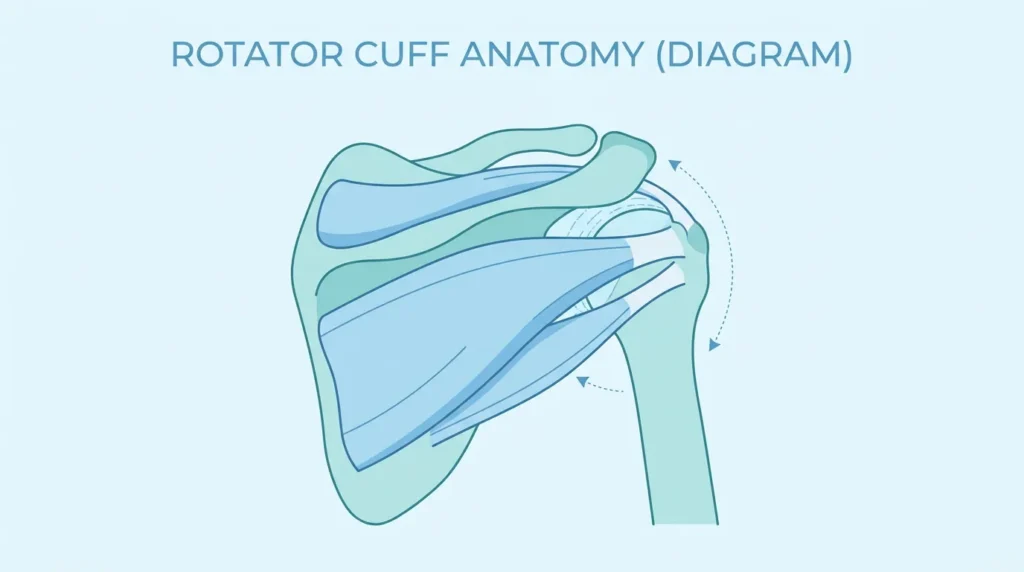
Rotator cuff pain usually develops when these tendons become irritated from repeated use, increased load, or reduced tolerance to activity. Rather than a sudden injury, many people notice symptoms building over time during normal daily activities.
Because the shoulder is such a mobile joint, the rotator cuff plays an important role in maintaining smooth, controlled movement. When these tissues become irritated, the shoulder may feel painful, weak, or stiff during certain motions.
What Does Rotator Cuff Pain Feel Like?
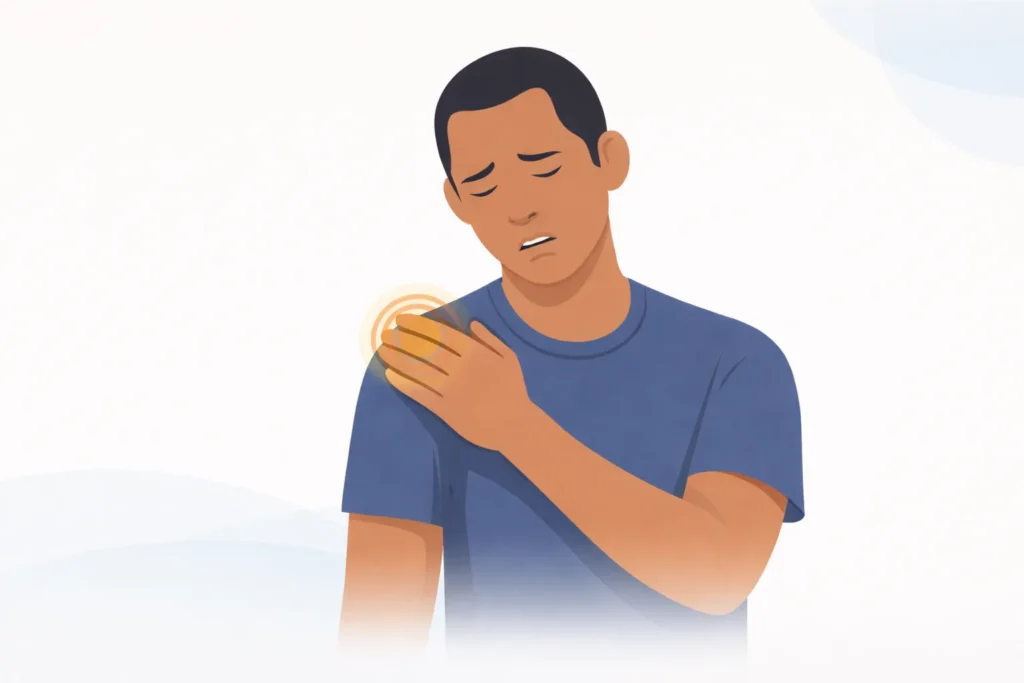
Rotator cuff pain usually shows up during movement rather than at complete rest. Many people experience discomfort when the arm moves away from the body or is raised overhead.
The pain is often felt on the outside of the shoulder or upper arm. Some people describe it as a dull ache, while others notice a sharper pain during certain motions.
| Symptom pattern | What patients usually notice |
|---|---|
| Pain with overhead reaching | Discomfort when reaching into cabinets or lifting the arm |
| Pain lifting objects | Shoulder feels sore when carrying groceries or weights |
| Pain reaching behind the body | Difficulty putting on a jacket or fastening clothing |
| Night discomfort | Pain when lying on the affected shoulder |
| Weakness during arm elevation | The arm feels harder to lift or less controlled |
Many people also notice that symptoms increase with repeated use. Activities like painting, swimming, lifting weights, or overhead work may irritate the shoulder later in the day. Night pain is also common, especially when lying on the affected shoulder.
Rotator Cuff Pain vs. Rotator Cuff Tear
Many people worry that shoulder pain means the rotator cuff is torn. While tears do happen, most shoulder pain seen in physical therapy is related to tendon irritation rather than a large tear.
Rotator cuff irritation means the tendon has become sensitive to movement or load. A tear is structural damage to the tendon itself. Some tears cause significant weakness, but many smaller tears do not.
Symptoms that often fit tendon irritation include:
- Pain with overhead movement
- Discomfort when lifting objects
- Soreness after activity
- Pain when sleeping on the shoulder
- Mild weakness due to pain
Imaging findings also do not always match symptoms. Many adults have partial rotator cuff tears on MRI without having much pain. That is why experienced physical therapists focus heavily on movement testing and symptom behavior during evaluation.
Why Image Findings Don’t Always Match Symptoms
Research has shown that many adults have rotator cuff changes on imaging even without shoulder pain.
For example, MRI studies have found partial rotator cuff tears in people who have completely normal shoulder function. Because of this, imaging findings alone do not always explain symptoms.
Physical therapists focus on how the shoulder behaves during movement rather than relying only on imaging results.
How Symptoms Behave During Daily Activity
Rotator cuff pain often changes with how the shoulder is used throughout the day. Many people feel relatively comfortable at rest but notice symptoms when the arm is loaded, lifted away from the body, or moved overhead.
Symptoms often fluctuate from day to day, depending on how the shoulder is used. The shoulder may feel manageable during activity, then more sore later in the evening after repeated use. Some people also notice mild morning stiffness that improves with movement, only to return after heavier activity.
| Activity | The shoulder often feels comfortable |
|---|---|
| Reaching overhead | Pain or pinching during the middle of the movement |
| Carrying objects | Shoulder fatigue or soreness |
| Repetitive arm use | Symptoms increase later in the day |
| Sleeping on the shoulder | Night pain or sleep disturbance |
| Resting with the arm at the side | Shoulder often feels comfortable |
Some people also notice a “painful arc” when raising the arm. The shoulder may feel comfortable at the start of the movement, painful in the middle, and less painful once the arm is fully overhead. This pattern is common with rotator cuff irritation and helps guide the evaluation process.
Does Rotator Cuff Pain Cause Weakness or Loss of Motion?
Some people notice weakness when rotator cuff pain develops. In many cases, this weakness is caused more by pain than by major tissue damage.
When the shoulder becomes irritated, the body often limits the strength of muscle contractions. This can make the arm feel weaker during lifting, reaching, or overhead movement.
Rotator cuff irritation can also lead to mild stiffness. Many people notice reduced comfort when reaching behind the back, putting on a jacket, or lifting the arm overhead.
This loss of motion is often related to pain and muscle guarding rather than a true mechanical block. As irritation settles and strength improves, movement usually follows suit.
What Causes Rotator Cuff Pain?
Rotator cuff pain usually develops when the shoulder is loaded beyond its current tolerance. This can happen with sudden increases in activity, repetitive overhead movement, or reduced strength and control around the shoulder.
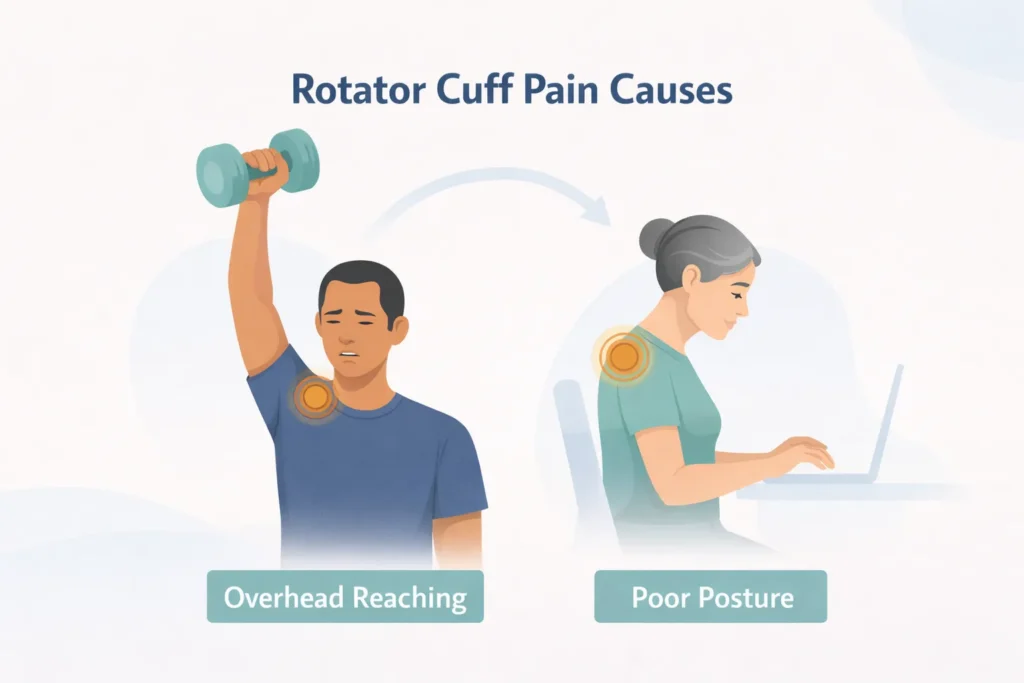
The shoulder depends on coordinated muscle function during reaching, lifting, and carrying. When movement becomes inefficient or certain tissues fatigue, the rotator cuff can become irritated.
Several factors can contribute to this problem:
- Repetitive overhead activity
- Sudden increase in training or exercise
- Poor shoulder mechanics
- Weakness in the surrounding muscles
- Reduced shoulder mobility
- Age-related tendon changes
A person may notice mild soreness at first, which slowly becomes more noticeable during daily activities.
Why Rotator Cuff Pain Often Develops Gradually
Many people expect shoulder pain to result from a single, obvious injury. In reality, rotator cuff irritation often builds over time.
The rotator cuff works every time the arm reaches, lifts, carries, or moves overhead. When those tissues are exposed to more stress than they are ready for, symptoms can gradually develop.
This often happens during normal life changes rather than dramatic injuries. A person may return to exercise after time off, increase overhead lifting, start a throwing sport, or take on more repetitive work at home or on the job.
This gradual pattern is one reason physical therapy focuses on improving load tolerance instead of simply shutting activity down.
Rotator Cuff Pain vs. Shoulder Impingement
Many people hear the terms “rotator cuff pain” and “shoulder impingement” used interchangeably. While they are related, they are not exactly the same thing.
Rotator cuff pain refers to irritation of the tendons that help control the shoulder joint. Shoulder impingement is a condition in which the tendons become compressed or irritated during certain arm movements.

In practical terms, the symptoms often overlap. Both conditions may cause pain during overhead movement, lifting, or reaching away from the body. The difference is mostly about how the problem is described.
| Term | What it generally refers to |
|---|---|
| Rotator cuff pain | Irritation or overload of the rotator cuff tendons |
| Shoulder impingement | Mechanical compression or irritation of the tendons during arm movement |
In modern rehabilitation, clinicians often focus less on labeling the condition and more on understanding how the shoulder responds to movement and load.
Shoulder pain treatment usually focuses on improving shoulder strength, coordination, and tolerance to activity so the rotator cuff can function comfortably again.
How Physical Therapy Evaluates Rotator Cuff Pain
A physical therapy evaluation focuses on understanding how the shoulder behaves during real movement, not just where the pain is located. The goal is to identify which activities aggravate symptoms and why those movements are irritating the rotator cuff.
| What the therapist evaluates | Why it matters |
|---|---|
| Shoulder movement patterns | Identifies movements that irritate the rotator cuff |
| Rotator cuff strength | Determines whether weakness is contributing to symptoms |
| Shoulder blade control | Poor control can increase strain on the shoulder |
| Upper back mobility | Limited mobility can affect overhead motion |
| Symptom response to repeated movement | Helps determine how irritable the shoulder is |
The assessment usually begins with a discussion about symptom history, exercise habits, work demands, and daily activities. A therapist will ask when pain appears, which movements trigger it, and what positions feel better or worse.
Movement testing is an important part of the evaluation. The therapist may assess how the shoulder moves during reaching, lifting, or overhead motion.
Common parts of the assessment include:
- Observing shoulder movement patterns
- Testing shoulder strength
- Checking shoulder mobility
- Evaluating neck and upper back motion
- Identifying positions that reproduce symptoms
Therapists also pay attention to how symptoms respond to repeated movement. For example, lifting the arm several times may reveal fatigue or increased pain that was not obvious during the first few repetitions.
Functional tasks may also be assessed. Activities like reaching overhead, carrying objects, or pushing against resistance can reveal how the shoulder behaves during everyday movement.
Imaging, such as MRI or ultrasound, is sometimes used but not always necessary. Many people have rotator cuff changes on imaging without having pain, so a movement assessment is often more useful in guiding treatment.
Most people improve with conservative care when the shoulder is gradually reintroduced to movement and strengthening.
How Physical Therapy Helps Rotator Cuff Pain
Physical therapy focuses on helping the shoulder tolerate movement again. The goal is to gradually rebuild strength, coordination, and load tolerance.
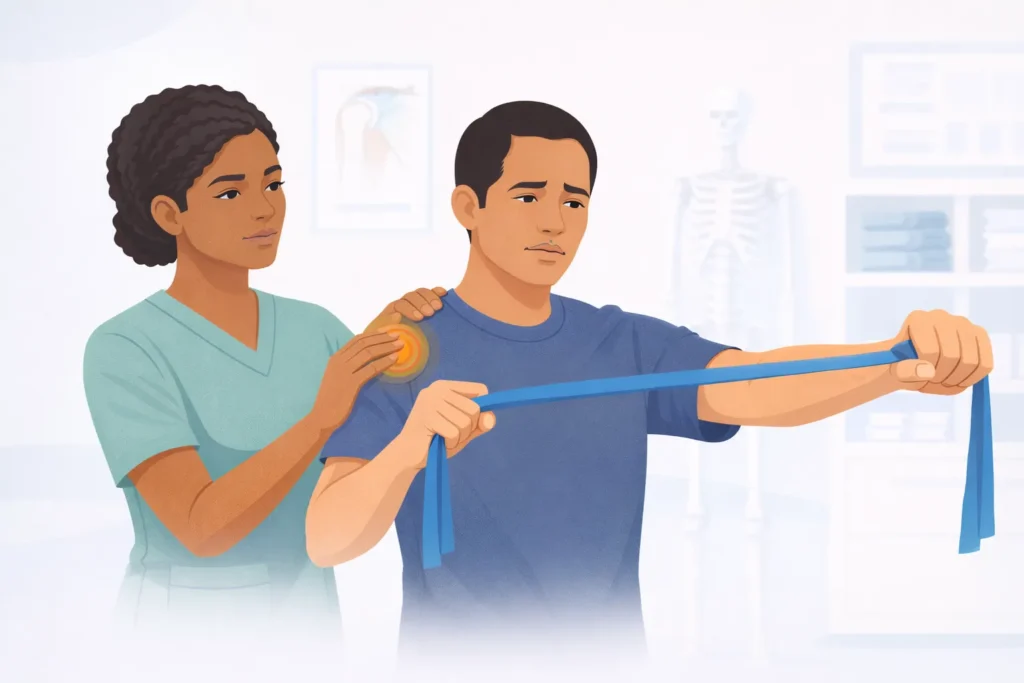
One important principle in shoulder rehabilitation is gradual exposure to load. Tendons usually respond well to progressive strengthening when the increase in stress is controlled.
Early treatment often focuses on reducing irritability. This may involve modifying certain activities, improving shoulder mechanics during daily tasks, and restoring comfortable movement.
Key treatment goals often include:
- Improving shoulder mobility
- Strengthening the rotator cuff
- Improving shoulder blade control
- Restoring overhead movement
- Gradually increasing load tolerance
Rehabilitation usually progresses through stages as the shoulder becomes more tolerant of load. Early exercises often focus on controlled movement with minimal irritation.
As symptoms improve, strengthening becomes more progressive, and later stages may include more demanding overhead or sport-specific activity.
| Stage of rehab | Focus of treatment |
|---|---|
| Early stage | Reduce irritability and restore comfortable movement |
| Strength stage | Improve rotator cuff and shoulder blade strength |
| Load progression | Gradually increase lifting and overhead activity |
| Return to activity | Reintroduce sport or exercise movements safely |
This gradual progression helps the rotator cuff tolerate everyday tasks again, including lifting, exercise, and sports.
Returning to Exercise and Sports
Many active adults with rotator cuff pain want to know when it is safe to return to exercise or sports.
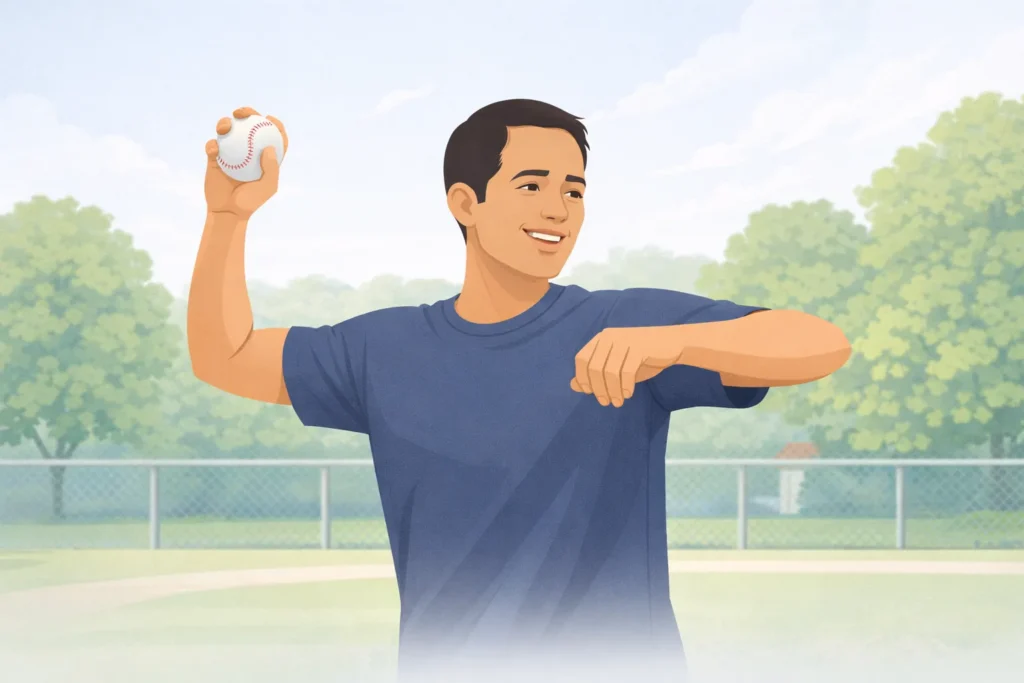
A common mistake is stopping all activity out of fear of worsening the shoulder. In many cases, avoiding movement entirely can actually lead to increased stiffness and weakness.
A better approach is to modify the activity while the shoulder rebuilds strength and tolerance.
That usually depends on how well the shoulder tolerates progressive loading during rehabilitation. As strength improves and symptoms decrease, activity can gradually increase.
In many cases, people can continue some forms of exercise during recovery. Lower-body training, running, and core work are often possible as long as the shoulder is not heavily stressed.
Overhead lifting, throwing, or high-volume upper body training may need temporary modification while the rotator cuff rebuilds tolerance.
When to See a Physical Therapist
Rotator cuff pain sometimes improves with temporary activity modification. However, symptoms that continue for several weeks or interfere with daily tasks are a good reason to seek evaluation.
Physical therapy can help identify the movement patterns contributing to irritation and provide a clear recovery plan.
You may benefit from an evaluation if you notice:
- Shoulder pain during overhead activity
- Difficulty lifting objects
- Persistent night pain
- Weakness in the shoulder
- Symptoms that limit exercise or sports
Early treatment often helps people return to activity more comfortably and avoid prolonged irritation.
Getting Help for Rotator Cuff Pain
Rotator cuff pain can be frustrating, especially when it starts to interfere with exercise, sleep, or daily activity. Thankfully, many shoulder problems respond well to guided movement and progressive strengthening.
A physical therapy evaluation can help identify what is driving your symptoms and develop a plan to restore comfortable shoulder function.
At Calibration Physical Therapy, treatment focuses on understanding how your shoulder moves, improving load tolerance, and helping you return to the activities you love.
Tags

About the Author
Dr. Traci Smiley, DPT
Traci is a licensed physical therapist and owner of Calibration Physical Therapy, serving the Kansas City area. A Board-Certified Orthopedic Clinical Specialist with advanced training in manual therapy and strength conditioning, she helps individuals overcome pain and return to what they love.