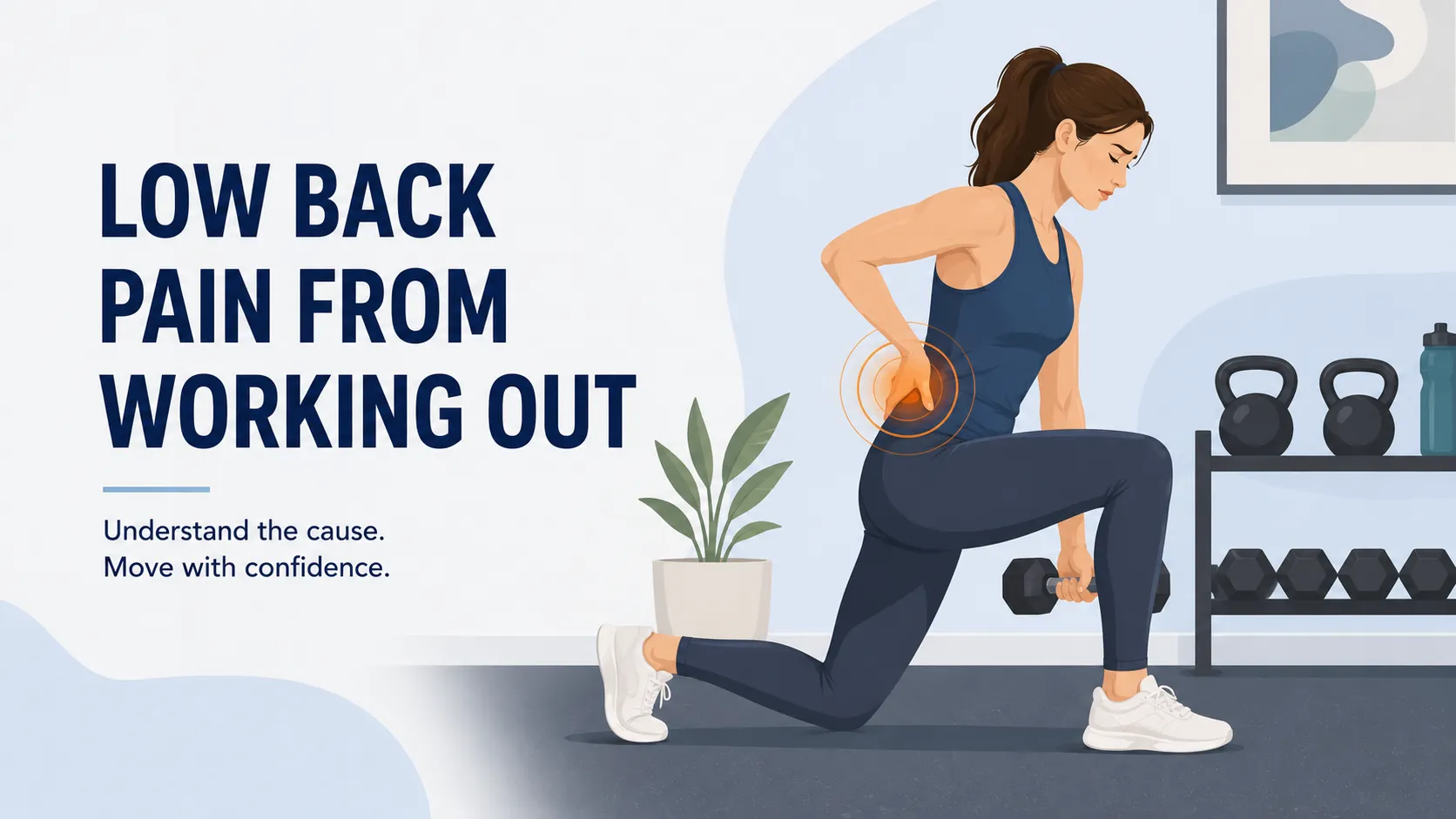
Low back pain from working out can show up during lifting, running, high-intensity training, recreational sports, or even later in the day after a hard session. Some people notice mild stiffness, while others feel pain sharp enough to change how they move or exercise.
This type of pain often affects active adults who are trying to stay consistent with workouts but are asking their back to handle more than it is currently prepared for. That does not automatically mean something is seriously damaged. In many cases, symptoms reflect a mismatch between training demands, recovery, and current conditioning.
People commonly notice symptoms during movements involving bending, bracing, rotation, or repeated impact. Deadlifts, squats, kettlebell work, rowing, sprinting, and rotational exercises are common triggers, but symptoms may also appear afterward while sitting, driving, or getting out of bed the next morning.
This article explains why workout-related low back pain happens, what symptoms commonly feel like, and how physical therapy helps people return to activity safely and progressively.
What Causes Low Back Pain from Working Out?
Low back pain related to exercise is usually influenced by several factors rather than one isolated issue. In many cases, the back becomes irritated when training demands increase faster than the body can comfortably tolerate.
Sometimes this happens after a sudden jump in volume or intensity. Someone may go from working out twice a week to six days a week, restart lifting after months off, increase running mileage too quickly, or add unfamiliar movements their body has not practiced recently.
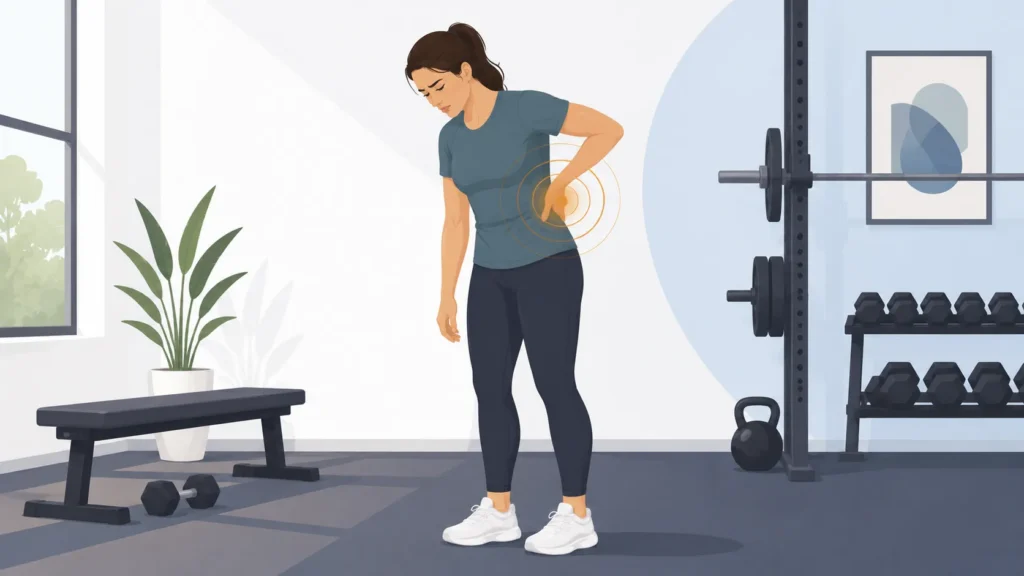
Recovery also matters. Poor sleep, limited rest between hard sessions, stress, and repeated high-intensity workouts can all reduce the body’s ability to handle training load. People often notice symptoms becoming more consistent during periods when they are trying to push through accumulated fatigue.
Several movement and physical factors can also contribute:
- Limited hip mobility that shifts more motion into the lower back
- Reduced trunk or hip strength during loaded movements
- Repetitive bending or rotation without enough recovery
- Poor tolerance to sustained sitting combined with intense training
- Returning to heavy lifting too quickly after symptoms improve
- Training through increasing stiffness without adjusting workload
Not every episode of low back pain is caused by poor form. Technique can matter, especially under heavier loads, but symptoms often reflect a broader mismatch between workload, conditioning, recovery capacity, and movement tolerance.
What Does Low Back Pain from Working Out Feel Like?
Low back pain during workouts does not always feel the same from person to person. Some people notice a dull ache or tightness in the lower back, while others experience sharper pain during certain movements, positions, or heavy lifts.
Pain is commonly felt around the beltline, slightly off to one side, or across both sides of the lower back. Some people mainly notice stiffness after training sessions, while others feel symptoms most during loaded exercises like squats, deadlifts, lunges, or kettlebell work.
The table below outlines common symptom patterns people report during workouts and daily activities.
| What people often notice | What it may feel like |
|---|---|
| Pain during bending or lifting | Sharp or pinching discomfort when loading the back |
| Morning stiffness | Tightness that improves after moving around |
| Pain after workouts rather than during them | Delayed soreness or irritation later in the day |
| Symptoms with prolonged sitting | Aching or stiffness after desk work or driving |
| Pain during repeated workouts | Increasing discomfort as fatigue builds |
| Temporary relief with movement | Stiffness that eases after walking or light activity |
Some people also notice symptoms around the glutes or upper hip region. That does not automatically mean sciatica or a disc injury. Muscle irritation, joint sensitivity, and movement-related pain can all cause symptoms in the pelvis and hips.
Symptoms may also fluctuate significantly from day to day. Someone might tolerate a workout well earlier in the week but feel noticeably stiffer during a similar session later on, when sleep, recovery, stress, or fatigue have changed.
How Symptoms Behave During Activity
Workout-related low back pain is often influenced more by repetition, fatigue, intensity, and recovery than by a single movement.
Someone may tolerate lighter sets without much difficulty, but may begin to notice pain as weight increases or fatigue changes movement quality. Others feel relatively normal during exercise but become stiff afterward while sitting at work or driving home.
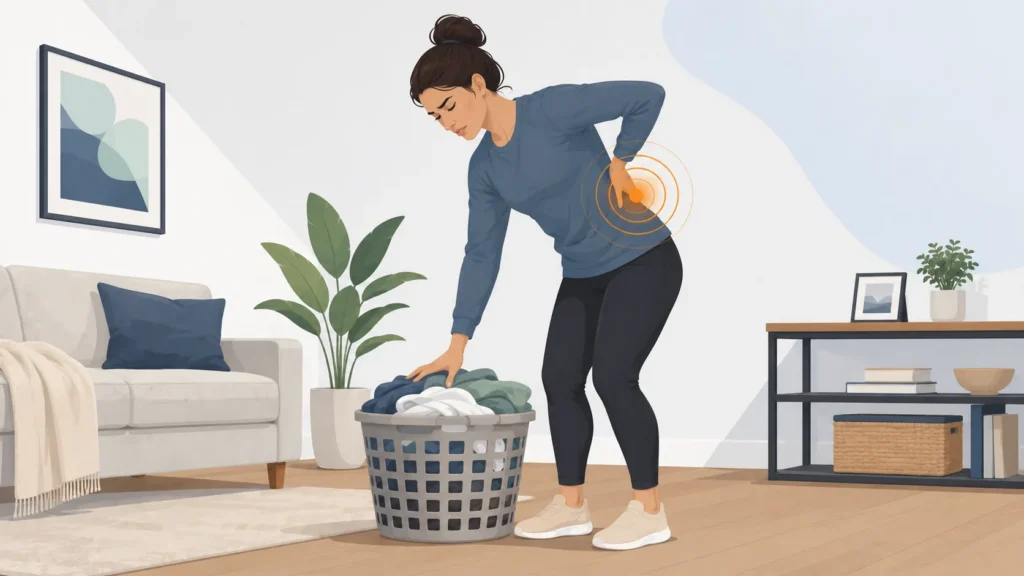
Repeated bending, heavy loading, rotational exercises, and high-volume training often become more uncomfortable when the back is already sensitive.
People commonly notice patterns like:
- Pain increasing after several sets rather than immediately
- Stiffness building later in the day after workouts
- Better tolerance to movement than prolonged sitting
- Increased soreness after multiple hard training days in a row
- Symptoms that linger longer as fatigue accumulates
The response to activity over the next 24 to 48 hours is often more important than the discomfort from a single exercise or workout.
Common Mistakes People Make When Symptoms Start
One common mistake is repeatedly testing painful movements throughout the day to see whether the pain persists. Constantly bending, stretching aggressively, or pushing through painful workouts can keep the back irritated instead of allowing symptoms to settle.
The opposite problem also happens frequently. Some people stop moving almost entirely because they are worried that exercise is causing damage. In many cases, too little movement can increase stiffness and make returning to activity feel harder.
Another common issue is returning to full training intensity too quickly once symptoms improve. Pain often settles faster than strength, conditioning, and workload tolerance fully recover.
People also tend to search for a single cause, such as a single lift or a moment during a workout. More often, low back pain related to exercise develops from a combination of workload, fatigue, recovery demands, and repeated stress over time.
Why Symptoms Often Develop Gradually
Many workout-related low back issues develop slowly over time rather than result from a single major injury. Early symptoms are often mild enough that people ignore them or assume they are dealing with normal soreness.
Someone may notice stiffness after deadlifts, tightness during long drives, or soreness that lasts longer than usual after harder workouts. Because symptoms often improve quickly at first, it is easy to continue training without making adjustments.
Over time, repeated loading without enough recovery can make the back less tolerant to certain activities. Movements that once felt manageable may begin causing symptoms more consistently, especially during periods of higher training volume or accumulated fatigue.
This gradual progression is common when people increase their workload faster than their body is prepared to handle. Rapid mileage increases, restarting intense training after time away, and stacking high-intensity workouts with poor recovery are common examples.
The body generally adapts well to exercise when progression and recovery stay reasonably balanced. Problems become more likely when the workload consistently outpaces recovery.
Low Back Strain vs Disc-Related Pain
Not all low back pain during workouts behaves the same way. Two people can describe “back pain” while having very different symptom patterns, movement limitations, and recovery behavior.
Some symptoms are more muscular and fatigue-related, while others become more sensitive to bending, sitting, or sustained positions. That does not mean one presentation is automatically more serious than the other, but the pattern of symptoms can influence how rehabilitation is approached.
The comparison below highlights a few common differences people may notice.
| Symptoms people notice | More common with muscular irritation | More common with disc-related irritation |
|---|---|---|
| Pain location | Broad ache or tightness | More focused or deeper pain |
| Response to movement | Often improves with warm-up | May worsen with repeated bending or sitting |
| Morning symptoms | General stiffness | Stiffness with sharper pain during flexion |
| Pain during lifting | Fatigue-related soreness | More positional sensitivity |
| Symptoms into the leg | Less common | More likely in some cases |
These categories can overlap, and symptoms alone do not confirm a diagnosis. This is why a movement-based evaluation is usually more helpful than self-diagnosing based on internet descriptions alone.
How Physical Therapy Evaluates Low Back Pain from Working Out
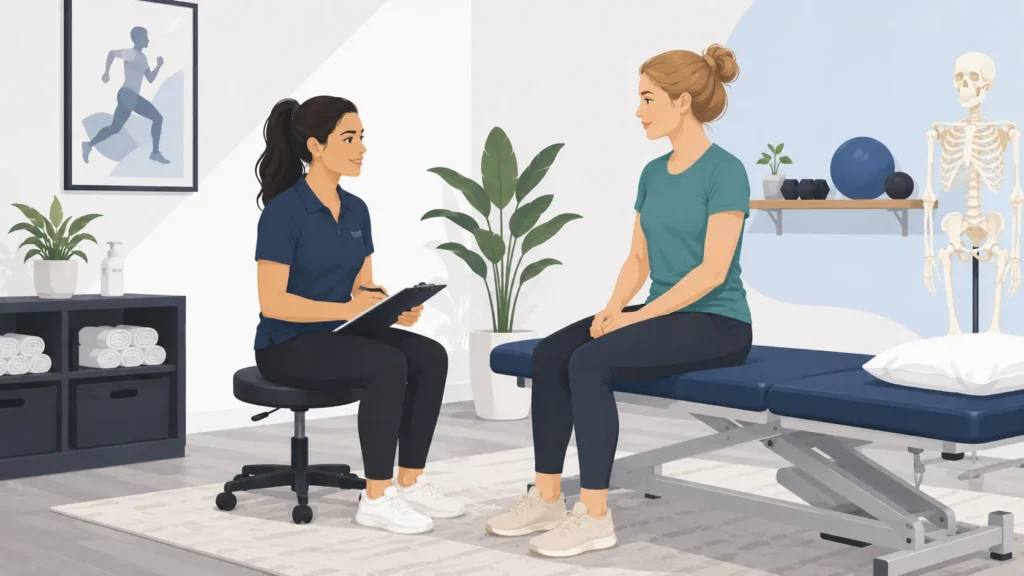
A physical therapy evaluation focuses on understanding how symptoms respond to movement and activity rather than simply identifying where pain is located.
The process usually starts with questions about training history, symptom progression, workout volume, recovery habits, and which activities increase or reduce discomfort. Sitting tolerance, lifting history, work demands, and exercise frequency often provide useful context.
Movement testing is then used to evaluate how the back responds to bending, extension, rotation, bracing, and repeated movement exposure.
| During evaluation | What it may help identify |
|---|---|
| Squat or hinge mechanics | Movement strategies that increase stress on the back |
| Hip mobility testing | Areas where the lower back may compensate |
| Repeated bending or extension | Directional sensitivity and symptom response |
| Core and hip strength testing | Load tolerance and muscular control |
| Functional movement assessment | Activity-specific limitations |
Imaging is not always necessary for workout-related low back pain. Many people improve with appropriate exercise progression, movement retraining, and workload management.
How Physical Therapy Helps Low Back Pain from Working Out
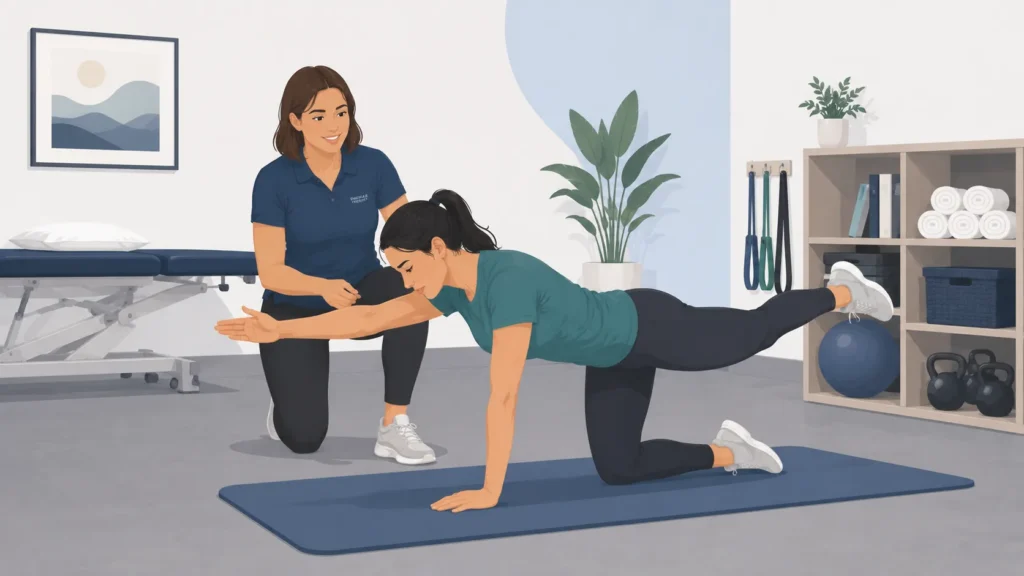
Physical therapy focuses on improving movement tolerance and helping people return to activity with more confidence.
Early treatment often involves temporarily modifying aggravating workouts while keeping the person as active as possible. This may include adjusting lifting volume, exercise selection, running intensity, or training frequency as symptoms subside.
As symptoms improve, rehabilitation shifts toward rebuilding strength, coordination, and tolerance to loading. Exercises are selected based on the person’s goals, movement limitations, and training demands, rather than using a single generic approach for everyone.
Treatment commonly focuses on:
- Improving trunk and hip strength
- Restoring comfortable bending and rotational movement
- Improving tolerance to loaded exercise
- Reintroducing painful or avoided movements gradually
- Building better recovery capacity between workouts
The goal is not to completely avoid discomfort forever. The goal is to improve resilience, confidence, and consistency so exercise becomes sustainable again.
Rehabilitation Progression
Rehabilitation usually progresses in stages as the back becomes more comfortable with movement and loading again.
Early rehab is often focused on reducing symptom-related irritability and restoring comfortable daily movement rather than aggressively strengthening the back. As tolerance improves, exercises and activities gradually become more demanding.
| Rehab phase | Main goal |
|---|---|
| Early phase | Reduce irritation and maintain comfortable movement |
| Middle phase | Improve strength, mobility, and loading tolerance |
| Advanced phase | Reintroduce heavier or more dynamic training |
| Return to activity | Build consistency and confidence with normal workouts |
Progression is rarely perfectly linear. Temporary increases in soreness can happen as activity levels increase, especially after returning to exercises that were previously painful or avoided.
Part of rehabilitation is learning how to interpret those responses appropriately. Mild soreness after activity can behave very differently from symptoms that continue escalating for several days or significantly limit normal movement afterward.
Returning to Activity
Returning to workouts after low back pain usually goes more smoothly when activity is progressed gradually instead of all at once.
Many people benefit from temporarily reducing workout volume, intensity, or frequency before building back toward their normal routine. That may involve lowering weight, shortening sessions, reducing mileage, or spacing harder workouts farther apart while symptoms settle.
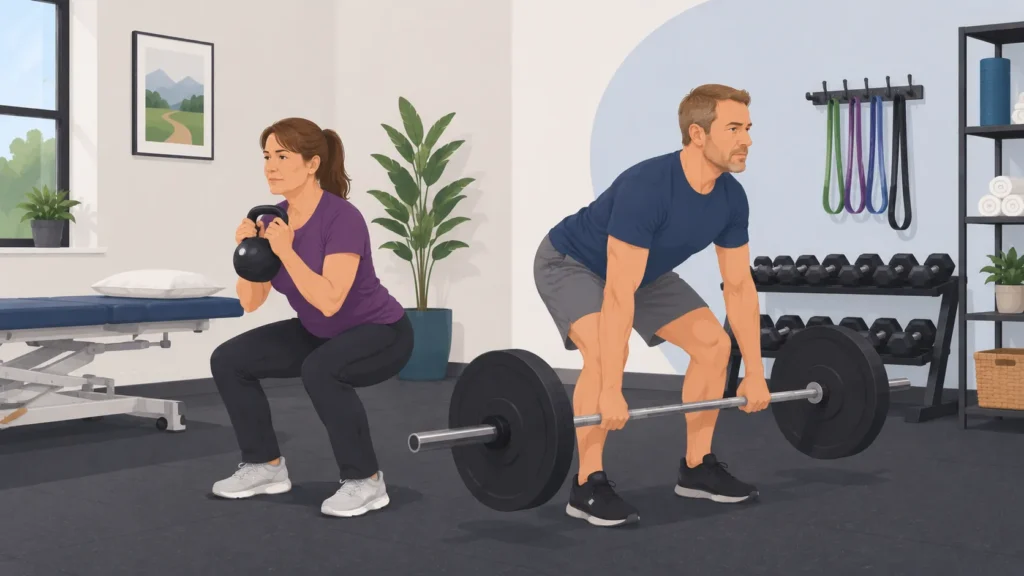
Recovery between sessions becomes especially important during this phase. Mild soreness that improves within a reasonable timeframe is usually more manageable than symptoms that continue building from workout to workout.
People also commonly become hesitant to move areas that previously caused pain, especially when bending or lifting. Gradually reintroducing those movements in a controlled way helps rebuild confidence while improving long-term tolerance to activity.
When to See a Physical Therapist
It may be helpful to see a physical therapist if:
- Symptoms persist beyond a few weeks
- Pain repeatedly returns during workouts
- Sitting, sleeping, or work tasks become difficult
- Exercise tolerance continues decreasing
- You feel uncertain about how to modify training safely
- Symptoms are limiting normal activity or fitness goals
A physical therapy evaluation can help clarify which types of movement and loading contribute to symptoms and provide a more structured plan for returning to activity.
Final Thoughts
Low back pain from working out is often related to how the body responds to workload, recovery, conditioning, and training progression over time. Symptoms can range from mild stiffness after exercise to more persistent discomfort that affects workouts and daily activity.
In many cases, people improve when they better understand how symptoms respond to activity and gradually rebuild strength and exercise tolerance, rather than avoiding movement completely.
Get Treatment for Low Back Pain
At Calibration Physical Therapy in Overland Park, Kansas, we help active adults, runners, lifters, and athletes understand what is contributing to their symptoms and build practical rehabilitation plans that support a confident return to activity.
If you’re experiencing low back pain from lifting and activities and live in the Kansas City area, book a physical therapy evaluation with us to start your recovery and get back to full strength.
Tags

About the Author
Dr. Traci Smiley, DPT
Traci is a licensed physical therapist and owner of Calibration Physical Therapy, serving the Kansas City area. A Board-Certified Orthopedic Clinical Specialist with advanced training in manual therapy and strength conditioning, she helps individuals overcome pain and return to what they love.